
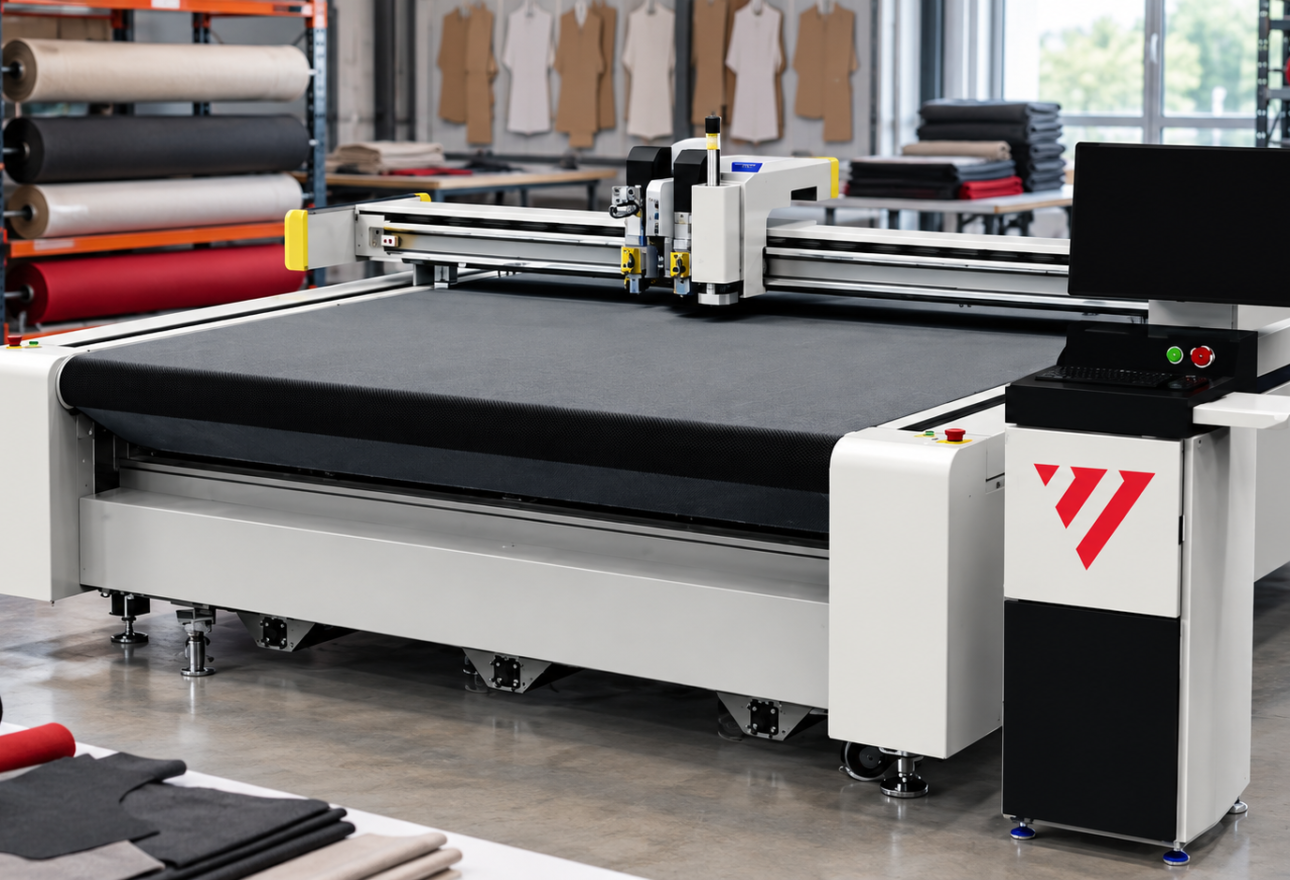
What Is an Automatic Fabric Cutting Machine?
An automatic fabric cutting machine is a computer-controlled industrial cutting system that converts digital CAD patterns into accurately cut physical components.
Instead of an operator manually tracing and cutting every pattern, digital pattern data is sent to the cutting system. The machine then follows the geometry of the pattern using the appropriate cutting tool.
A typical digital workflow looks like this:
CAD Pattern → Marker/Nesting → Digital Cutting File → Automatic Cutting Machine → Cut Components → Sewing/Assembly
Depending on the equipment and material, an automatic cutter may use technologies such as:
- Oscillating knife
- Rotary or circular knife
- Drag knife
- Driven rotary tool
- Punch
- Drill
- Notching tool
- Pen/marking tool
- Laser
- Other application-specific tooling
The correct technology depends on the material being processed and the manufacturer’s production requirements.
What Is a Single-Ply Cutting Machine?
A single-ply cutting machine is an automated digital cutter designed primarily to cut one layer, or a limited layup depending on the material and application, rather than a compressed stack of many fabric layers.
Single-ply cutting is particularly useful for manufacturers with:
- High product variety
- Frequent pattern changes
- Short production runs
- Custom manufacturing
- Made-to-order production
- Prototyping
- Sampling
- Technical materials
- Expensive materials
- Variable-size components
- Digitally driven production workflows
- The major advantage is flexibility.
Instead of creating large fabric lays containing many identical pieces, manufacturers can move rapidly from one digital cutting job to another.
This makes single-ply cutting especially attractive for modern high-mix, low-to-medium-volume manufacturing environments.
Single-Ply vs. Multi-Ply Cutting: What’s the Difference?
One of the first decisions manufacturers need to make is whether they require a single-ply or multi-ply cutting system.
| Single-Ply Cutting | Multi-Ply Cutting |
|---|---|
|
Cuts individual or limited layers |
Cuts stacked layers |
|
Excellent for customization |
Excellent for repetitive volume |
|
Fast job changeovers |
Optimized for larger production runs |
|
Good for short runs |
Good for mass production |
|
Suitable for many technical materials |
Common in large apparel production |
|
Digital/on-demand workflow |
Lay preparation typically required |
|
Less dependency on large production batches |
Can cut many identical components simultaneously |
Neither technology is automatically better.
The correct choice depends on the manufacturing environment.
A large apparel factory producing thousands of identical garments may benefit from multi-ply cutting.
A manufacturer producing custom upholstery, technical sewn products, prototypes, performance products, composites or rapidly changing production orders may find single-ply digital cutting more appropriate.
What Industries Use Automatic Fabric Cutting Machines?
Automatic cutting extends far beyond conventional apparel manufacturing.
Modern digital cutting systems can be used throughout the sewn-products and industrial-materials sectors.
Apparel and Garment Manufacturing
Applications can include:
– Shirts
– Pants
– Dresses
– Jackets
– Uniforms
– Sportswear
– Workwear
– Activewear
– Costumes
– Fashion samples
– Custom garments
– Automated cutting can help apparel manufacturers transition from manual pattern cutting toward a more integrated CAD-to-production workflow.
Furniture and Upholstery Manufacturing
Furniture manufacturers can use automated cutting for:
– Sofa upholstery
– Chair components
– Cushions
– Furniture covers
– Decorative textiles
– Foam components
– Synthetic upholstery materials
– Leather and compatible leather-like materials
– Digital cutting can be particularly valuable when a manufacturer produces numerous furniture models, sizes and customer configurations.
Automotive Interiors
Automotive and transportation applications may include:
– Seat materials
– Interior trim
– Carpet
– Insulation
– Headliner-related materials
– Technical textiles
– Foam
– Protective components
– Composite materials
– Digital cutting allows complex CAD geometry to be reproduced consistently across production.
Marine Manufacturing
Marine applications can include:
– Boat covers
– Marine canvas
– Seat upholstery
– Enclosures
– Bimini tops
– Protective covers
– Interior textiles
– Foam
– Vinyl and compatible flexible materials
– Custom marine work is especially well suited to digital workflows because dimensions and configurations can vary substantially from one project to another.
Aerospace and Aviation
Aerospace manufacturers and suppliers may work with:
– Technical textiles
– Composite reinforcement materials
– Insulation
– Interior materials
– Protective fabrics
– Specialized flexible materials
– For these industries, manufacturers should carefully validate the cutting process against the specific material, quality requirements, tolerances and applicable production standards.
Defense and Military Textile Manufacturing
Automated cutting may also be relevant to manufacturers producing sewn products and textile components for defense applications.
Potential applications can include:
– Tactical textile components
– Packs and load-carrying products
– Protective covers
– Equipment bags
– Performance textiles
– Technical fabrics
– Insulation
– Composite reinforcement materials
– Other sewn or flexible-material components
– Defense contractors should always evaluate equipment within their own contractual, quality, cybersecurity, traceability and regulatory requirements.
PPE and Protective Products
Digital cutting can also support manufacturers of certain personal protective and industrial sewn products, depending on the material and product requirements.
Applications may include:
– Protective garments
– Industrial covers
– Specialized textile assemblies
– Technical fabric components
– Workplace protection products
– The material should always be tested before production equipment is selected.
Technical Textiles and Industrial Fabrics
This is one of the broadest opportunities for automatic digital cutting.
Applications can extend to:
– Industrial fabrics
– Coated textiles
– Performance fabrics
– Technical films
– Flexible composites
– Reinforcement materials
– Insulation
– Filter materials
– Protective textiles
– Specialized sewn products
– In these environments, the machine should be selected around the material and process, not simply around the word “fabric.”
What Materials Can an Automatic Cutter Cut?
Material capability depends heavily on the cutting system, tool configuration, material properties and application.
Potential materials for appropriately configured digital cutting systems can include:
- Woven fabrics
- Knit fabrics
- Nylon
- Polyester
- Canvas
- Vinyl
- Leather
- Synthetic leather
- Foam
- Technical textiles
- Coated fabrics
- Fiberglass fabrics
- Carbon-fiber reinforcement fabrics
- Flexible composites
- Technical films
- Paper
- Cardboard
- Other compatible flexible materials
A manufacturer should never purchase an automatic cutter solely because a material appears on a compatibility list.
The Better Question Is:
Can the machine cut my exact material, at my required quality and production rate, using my actual CAD files?
That is why a material cutting evaluation can be one of the most valuable steps before purchasing.
What Cutting Tools Should You Look For?
Tooling is one of the most important considerations when selecting an automatic cutter.
Different materials behave differently under different cutting methods.
Oscillating Knife
An oscillating knife rapidly moves the blade while following the programmed cutting path.
Depending on the machine configuration and material, oscillating technology can be useful for various flexible and technical materials.
Circular or Rotary Knife
A circular knife uses a rotating blade and can be effective for certain textiles where rolling blade action produces a clean, efficient cut.
Drag Knife
A drag knife is pulled through the material along the cutting path.
It can be appropriate for specific thin or flexible materials depending on the application.
Pen or Marking Tool
A marking tool can add:
– Reference lines
– Identification
– Alignment information
– Assembly marks
– Production annotations
This can help connect cutting with downstream sewing and assembly operations.
Notching and Drilling
Certain production environments require reference points, notches or drilled locations to assist assembly.
When evaluating a cutter, don’t simply ask:
“How many tools does the machine have?”
Ask:
“Which tool produces the best result on the materials we manufacture?”
What Is the Velocity ProCut X?
The Velocity ProCut X is an industrial automatic digital cutting platform designed for single-ply cutting applications and flexible-material manufacturing.
It is intended for manufacturers looking to move from manual or less-automated cutting processes toward a digital CAD-to-cut workflow.
Depending on the configuration and application, ProCut X tooling can include:
– Oscillating Knife
– Circular Knife
– Drag Knife
– Pen/marking capability
– Optional production configurations can also include technologies such as material feeding and projection, depending on the model and application.
The ProCut X is designed to serve industries such as:
– Apparel
– Sewn products
– Furniture
– Upholstery
– Automotive
– Marine
– Technical textiles
– Industrial fabrics
– Leather goods
– Footwear
– PPE
– Composites
– Aerospace
– Defense-related textile manufacturing
The appropriate configuration should be determined by the customer’s actual materials, pattern dimensions, CAD workflow and production requirements.
What Size Automatic Cutter Do You Need?
Working area is critical.
Before selecting a machine, determine:
- Maximum pattern-piece dimensions
- Material roll width
- Typical nesting width
- Longest component
- Available floor space
- Whether roll-fed production is required
- Expected future material widths
Do not simply purchase the largest table available.
An oversized machine consumes additional floor space and capital.
An undersized machine can restrict production.
The correct working area should correspond to the actual products being manufactured.
Static Table vs. Conveyor Cutting System
Another important decision is whether the production process is better suited to a static cutting table or a conveyorized cutting system.
Static Cutting Table
A static table keeps the material on a fixed cutting surface.
This can be appropriate for:
– Sheet materials
– Large individual components
– Technical applications
– Operations where continuous roll feeding isn’t required
Conveyor Cutting System
A conveyorized cutter can advance material through the cutting area.
This can be advantageous for:
– Roll-fed fabrics
– Long markers
– Continuous production
– Higher-throughput workflows
– The correct system depends on material presentation, pattern length, workflow and production volume.
Why Is Vacuum Important?
Many automatic cutting systems use vacuum to help secure material during cutting.
This is important because flexible materials can move, wrinkle or shift while the cutting head travels.
Effective material hold-down can contribute to:
– Cutting consistency
– Pattern accuracy
– Cleaner edges
– Reduced material movement
– Better repeatability
Vacuum requirements vary considerably according to material porosity, thickness, cutting area and machine configuration.
This is another reason actual material testing is important.
CAD Compatibility: A Critical Purchasing Decision
The cutting machine is only one part of a digital manufacturing system.
The complete workflow may include:
Pattern Creation → CAD → Grading → Marker/Nesting → Cut File → Automatic Cutter
Before purchasing a machine, determine:
– Which CAD software your company currently uses
– Which file formats it exports
– Whether nesting is performed automatically or manually
– Whether file conversion is required
– Whether cut lines and internal marks are interpreted correctly
– How notches are processed
– How drill points are processed
– How different tools are assigned
– Whether the workflow has been tested with representative production files
A powerful cutting machine with a poorly planned CAD workflow can still create production problems.
Automatic Fabric Cutting vs. Manual Cutting
Manual cutting continues to have a place in manufacturing.
For extremely low production volumes, one-off work or certain specialized operations, manual cutting may remain economically practical.
As volume increases, however, manufacturers should evaluate the broader costs associated with manual processes.
These may include:
– Direct cutting labor
– Pattern handling
– Rework
– Operator variability
– Training
– Material waste
– Production bottlenecks
– Throughput limitations
– Difficulty scaling production
Automatic cutting can potentially reduce dependence on repetitive manual processes while improving consistency, but the financial benefit depends on the operation.
Automation should therefore be evaluated using actual production data rather than generic savings percentages.
How Much Does an Automatic Fabric Cutting Machine Cost?
Automatic cutting equipment represents a significant capital investment.
The final cost can depend on:
– Cutting area
– Static vs. conveyor configuration
– Tooling
– Vacuum requirements
– Material feeding
– Projection systems
– CAD/software requirements
– Installation
– Freight
– Training
– Warranty
– Technical support
– Accessories
For that reason, comparing only the initial purchase price can be misleading.
A better calculation is:
Equipment + Freight + Installation + Software + Training + Consumables + Maintenance + Support + Downtime = Total Cost of Ownership
Manufacturers should evaluate this over several years rather than only comparing initial quotations.
How Do You Calculate ROI on an Automatic Cutter?
A useful ROI analysis begins with the manufacturer’s current cutting operation.
Calculate:
Current annual cutting labor
– Material waste
– Rework/scrap
– Outsourced cutting costs
– Production bottleneck costs
– Maintenance on existing equipment
Then compare those costs against the projected automated process.
Also consider whether automation could create additional production capacity.
A simplified calculation is:
Annual Economic Benefit ÷ Total Investment = Approximate Annual ROI
Payback period can be estimated as:
Total Investment ÷ Estimated Monthly Economic Benefit = Approximate Payback Period
These calculations should be based on realistic, documented assumptions.
Can Automatic Cutting Reduce Material Waste?
Potentially, yes.
However, the cutter alone doesn’t determine material utilization.
Waste is influenced by:
– Pattern geometry
– Nesting efficiency
– Material width
– Defects
– Grain or directional requirements
– Spacing between pieces
– Cutting tolerances
– CAD software
– Operator decisions
A digital cutting workflow combined with effective nesting can help manufacturers control material usage more systematically.
For expensive technical fabrics, composites, leather and performance materials, even relatively small improvements in material utilization may have meaningful economic value.
What About Projection Systems?
Projection can be valuable when operators need visual guidance for:
– Pattern placement
– Material alignment
– Defect avoidance
– Printed-material positioning
– Component identification
– Specialized manufacturing workflows
Whether projection is necessary depends on the application.
It should be treated as a production tool rather than an accessory added simply because it is available.
What Should You Ask Before Buying an Automatic Fabric Cutter?
Before requesting a quotation, manufacturers should be prepared to answer:
- What materials are we cutting?
- What are their thicknesses and weights?
- What is our maximum material width?
- What is our largest pattern piece?
- Are we cutting rolls, sheets or both?
- How many pieces do we cut per day?
- How many cutting employees do we currently use?
- What CAD system do we use?
- Which file formats do we produce?
- Do we require nesting software?
- Do we need marking?
- Do we need notching?
- Do we need drilling?
- Do we need projection?
- Do we require continuous roll feeding?
- How much floor space is available?
- What is our current material waste?
- What is our current cutting labor cost?
- What level of technical support do we require?
- What growth do we anticipate over the next three to five years?
These questions allow the supplier to recommend a configuration based on actual production requirements rather than assumptions.
Should You Send Material for a Cutting Test?
Whenever practical, yes.
A cutting demonstration using your actual production material can provide considerably more information than specifications alone.
For a meaningful evaluation, send:
Actual production material
Representative CAD files
Small and large pattern pieces
Complex curves
Internal markings
Notches
Drill points, if applicable
Quality requirements
Then evaluate:
Cut quality
Edge quality
Dimensional accuracy
Material movement
Tool selection
Marking quality
Processing time
Ease of file preparation
The objective is not simply to prove that the machine can physically cut the material.
The objective is to determine whether it can cut that material to your production requirements.
Frequently Asked Questions About Automatic Fabric Cutting Machines
What is the best automatic fabric cutting machine?
There is no single machine that is best for every manufacturer.
The best automatic cutter is the system that matches the company’s materials, cutting width, pattern dimensions, production volume, CAD workflow, required tools, quality standards, support requirements and budget.
For manufacturers evaluating flexible-material single-ply automation, the Velocity ProCut X is one system to consider.
What is the difference between a CNC fabric cutter and an automatic fabric cutter?
The terms are frequently used interchangeably.
A CNC or computer-controlled digital cutter follows programmed geometry from digital files. “Automatic fabric cutter” is a broader commercial term commonly used to describe automated systems designed for textile and flexible-material cutting.
Can an automatic cutter cut more than fabric?
Yes, depending on the machine, tooling and material.
Appropriately configured digital cutters may process textiles, leather, foam, vinyl, composites, technical films, fiberglass fabrics, carbon-fiber reinforcement and other compatible flexible materials.
Always test the actual material before selecting equipment.
Is single-ply cutting good for custom manufacturing?
Single-ply cutting can be particularly well suited to custom, made-to-order and high-mix manufacturing because production can move between digital jobs without requiring large stacks of identical material.
Can automatic cutters work with CAD patterns?
Yes. Digital CAD integration is fundamental to automated cutting.
The complete workflow and file compatibility should nevertheless be verified before purchasing.
Is an automatic cutter better than manual cutting?
Not in every situation.
Manual cutting can remain practical for extremely low-volume work. Automated cutting becomes more compelling when manufacturers need greater repeatability, capacity, digital workflow integration or reduced dependency on repetitive manual cutting operations.
Can an automatic cutter cut Cordura, Nomex or technical fabrics?
Potentially, depending on the exact material construction, weight, coating, thickness and cutting-tool configuration.
Materials sold under broad categories such as Cordura or Nomex can have substantially different characteristics. Actual material testing is recommended before determining suitability.
Can automatic cutters cut carbon fiber and fiberglass?
Certain digital knife-cutting systems can process compatible dry carbon-fiber and fiberglass reinforcement materials.
The exact material and production requirements should be evaluated before equipment selection.
Do I need an oscillating knife or circular knife?
That depends on the material.
Different blade technologies perform differently across woven textiles, technical materials, composites, foam and other substrates. Testing the production material is the best way to determine the appropriate tooling.
Should I buy a static or conveyor cutter?
A static system can be appropriate for sheets, individual components and specialized applications.
A conveyor system may be preferable for continuous roll-fed production, long markers and workflows requiring automatic material advancement.
Is the Velocity ProCut X Right for Your Manufacturing Operation?
The ProCut X should be evaluated when your operation requires a digital single-ply CAD-to-cut workflow and your materials and production requirements match the available machine configuration.
Potential applications include:
Apparel • Sewn Products • Furniture • Upholstery • Automotive • Marine • Technical Textiles • Industrial Fabrics • Footwear • Leather • PPE • Composites • Aerospace • Defense
But equipment selection should never be based on the industry name alone.
Two furniture manufacturers can have completely different cutting requirements.
Two apparel manufacturers can have completely different production volumes.
Two companies using “carbon fiber” may be processing completely different materials.
The correct recommendation requires understanding the actual application.
Final Recommendation: How to Choose an Automatic Fabric Cutting Machine in 2026
When evaluating an automatic fabric cutter, don’t begin with:
“Which machine is fastest?”
Begin with:
What material are we cutting?
Then evaluate:
Material → Cutting Width → Pattern Size → Production Volume → Tooling → CAD Workflow → Automation → Quality → Support → Total Cost of Ownership → ROI
For manufacturers considering single-ply digital cutting, the Velocity ProCut X provides an automatic cutting platform that can be configured around different flexible-material manufacturing applications.
The most important step before purchasing is to validate the system against your actual production requirements.
Test Your Material on the Velocity ProCut X
If you are evaluating automated cutting, Velocity Plotters & Cutters can review your application before recommending a configuration.
For the most useful evaluation, provide:
– Material type
– Material width
– Material thickness or weight
– Typical pattern dimensions
– CAD software
– Representative CAD file
– Current cutting method
– Approximate production volume
– Current labor requirements
– Desired production goals
Whenever appropriate, arrange a material and CAD-file cutting evaluation using representative production materials.
The question isn’t simply:
“Can the ProCut X cut it?”
The more important question is:
“Can the ProCut X cut our material, using our patterns, at the quality and productivity our manufacturing operation requires?”
That is the question a serious equipment evaluation should answer.
Velocity Plotters & Cutters
Automatic Cutting Systems • Single-Ply Cutters • Pattern Plotters • Marker Plotters • Pattern Plotter Cutters • Pattern Digitizing • CAD/CAM Solutions

 EN_US
EN_US  ES
ES