

Last Updated: October 25, 2026
Quick Summary
Industry 4.0 in garment factories delivers seven core benefits: shorter production cycle time and higher throughput, lower production costs and less fabric waste, fewer defects through inline quality control, real-time monitoring and data collection, greater flexibility, stronger workforce capability, and a better competitive position. These gains concentrate first in the cutting room, where automated cutting and digital pattern handling remove queues and reduce fabric waste.
- A systematic review reports roughly 15% lower energy consumption alongside workflow gains from Industry 4.0 adoption.
- Start with digital pattern and marker generation, then automate cutting, then connect cutting data to sewing-line scheduling.
- Run your highest-volume styles through a digital nesting trial to test payback before buying.
- Plan several weeks of supervised ramp-up and name one system lead per shift during retraining.
- First-pass yield on a newly automated cutting line often dips for two to four weeks before exceeding the manual baseline.
Table of Contents
- What Industry 4.0 Actually Changes on a Garment Factory Floor
- The 7 Benefits of Industry 4.0 in Garment Factories
- Industry 4.0 Technologies in Fashion: What Garment Factories Actually Deploy
- Garment Manufacturing Automation: From Cutting Room to Finished Pack
- Fabric Cutting Automation and the Material Savings Behind It
- Industry 4.0 Workforce Impact: Retraining the Cutting Room
- How to Measure ROI Before You Commit to Factory Modernization
- Map Your Cutting Room Savings With a Velocity Plotters Walkthrough
- Frequently Asked Questions
What Industry 4.0 Actually Changes on a Garment Factory Floor
Industry 4.0 is the integration of connected machines, sensors, and data systems into production so that equipment reports on itself and decisions rest on live numbers instead of end-of-week guesswork. For the apparel-specific tools behind these changes, explore apparel manufacturing solutions for pattern plotting, marker production, digitizing, and fabric cutting.
Below, we break down the seven benefits that show up first, what each one requires, and how to measure payback before you commit capital.
The 7 Benefits of Industry 4.0 in Garment Factories
The benefits of Industry 4.0 in garment factories concentrate in seven areas: cycle time, cost, quality, visibility, flexibility, workforce capability, and competitive position. Each one depends on the others. Faster throughput means nothing if defects rise, and cost savings evaporate if inventory balloons. Here is how each benefit actually materializes.
1. Shorter Production Cycle Time and Higher Throughput
Cycle time falls first because automated cutting and digital pattern handling remove the queue between marker making and the cutting table. A systematic review of Industry 4.0 in the textile and apparel sector reports roughly a 15% reduction in energy consumption alongside these workflow gains, which signals that the efficiency improvements are systemic rather than isolated to one station. Research from Bujor and coauthors on Industry 4.0’s workforce impact identifies shorter production-cycle time and less time spent as core benefits.
2. Lower Production Costs and Less Fabric Waste
Fabric is the largest controllable cost in most cut-and-sew operations, so material use drives the entire cost equation. Digital marker plotting and automated cutting let you test nestings before a blade touches cloth, and the savings compound across every lay. For a deeper look at the mechanics, see our guide on how to reduce textile waste with CAD/CAM automation and the strategies in reducing fabric waste in apparel production.
3. Fewer Defects Through Inline Quality Control
Defect reduction moves upstream when sensors and connected machines flag problems during the run instead of at final inspection. Automated cutting removes the hand-tolerance variance that produces mismatched panels, and inline monitoring catches blade drift before it repeats across a hundred plies. The economic argument is simple: a defect caught at the cutter costs a few dollars of fabric, and the same defect caught at pack-out costs the fabric plus labor plus the reorder.
4. Real-Time Monitoring and Data Collection Across the Production Line
Data collection turns the floor into a feedback loop. Connected machines report cutting speed, yield, and downtime to a dashboard, and production managers adjust the schedule the same shift rather than the next morning. Datatex’s analysis of Industry 4.0 for the textile and clothing sector lists improved visibility across departments and faster, more accurate operational decision-making as the primary returns.
Industry 4.0 Technologies in Fashion: What Garment Factories Actually Deploy
Industry 4.0 technologies in fashion break into four practical categories: CAD/CAM pattern and marker software, automated cutting and plotting hardware, sensor networks on existing machines, and analytics layers that consolidate the data. Most factories do not buy all four at once. They start with the cutting room because that is where material cost and cycle time intersect, then add monitoring as the software matures. A 2024 review by Monteiro and coauthors on global Industry 4.0 practices in apparel confirms that connectivity among wireless sensors and devices is the common thread across adopters, not a single flagship technology.
Garment Manufacturing Automation: From Cutting Room to Finished Pack
Garment manufacturing automation follows a sequence, and getting the order wrong wastes money. Start with digital pattern and marker generation, then automate cutting, then connect the cutting data to sewing-line scheduling, and only then push analytics across the whole plant. If you are weighing hardware options, our comparison of the best industrial fabric cutting machines covers single-ply versus multi-ply trade-offs and the features that matter at each scale.
Fabric Cutting Automation and the Material Savings Behind It
Fabric cutting automation delivers savings through three levers: tighter nesting, reduced human error, and less remakes. A well-nested marker can recover several percentage points of yield versus a hand-laid one, and automated cutting holds that tolerance across every ply in the lay.
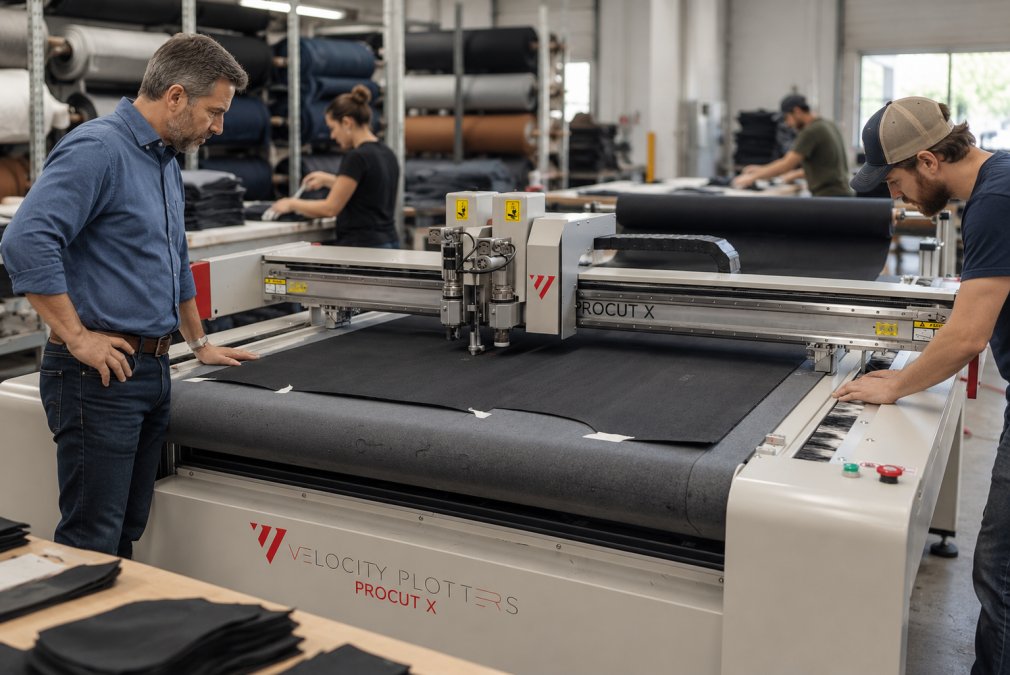
The savings are measurable before you buy. Run your highest-volume styles through a digital nesting trial and compare fabric consumption against your current manual markers. That single test tells you more about payback than any vendor demo.
Industry 4.0 Workforce Impact: Retraining the Cutting Room
Industry 4.0 workforce impact is usually overstated as job loss and understated as role change. The cutting room does not empty out; it shifts from manual spreading and hand cutting to machine supervision, marker optimization, and data review. The transition that fails is the one where operators are handed new software with a two-hour briefing and expected to hit the same output by Friday.
The role map: what actually changes, seat by seat
Most workforce guides stop at ‘retrain your people.’ A garment cutting room has a small number of distinct roles, and each one changes in a predictable way:
|
Role |
Before |
After |
Core new skill |
|---|---|---|---|
|
Spreader |
Lays fabric by hand to a chalk line |
Loads the spreader, sets tension and ply count, checks alignment against the marker |
Spread quality control and tension settings |
|
Cutter |
Guides a hand or band knife |
Supervises the automated cutter, loads the cut file, monitors blade condition |
File handling, fault recovery, blade and consumable checks |
|
Marker maker / pattern tech |
Manual or semi-manual marker layout |
Runs nesting software, tests multiple marker options, compares yield |
Nesting software, fabric-width and defect constraints |
|
Line supervisor |
Walks the floor, estimates WIP |
Reads bundle scans and OEE, reassigns work based on data |
KPI interpretation and daily huddle facilitation |
|
Maintenance tech |
Mechanical repair |
Sensor checks, connectivity troubleshooting, firmware and calibration |
Basic networking and digital diagnostics |
The pattern is consistent: nobody loses a job, but every job gains a data or software component. The factories that handle this well promote from within and pay for the new skill rather than hiring over their existing team.
A phased training sequence that survives a live production schedule
Training fails when it competes with output. Sequence it so each phase produces a visible win before the next begins:
- Shadow phase (week 1-2). The vendor or system lead runs the new equipment while the existing operator watches and asks questions. No output target on the trainee.
- Paired operation (week 3-4). Operator runs the machine with the system lead beside them. Output target set at roughly 70-80% of the manual baseline, not 100%.
- Supervised solo (week 5-6). Operator runs alone with the lead on call. Track first-pass yield and downtime per shift; intervene only on safety or quality escapes.
- Ownership (week 7+). Operator owns the daily startup checklist, the fault log, and one KPI. This is the step most factories skip, and it is the one that makes the skill stick.
The barriers nobody puts in the brochure
- Legacy equipment. Many sewing machines and spreaders have no data port and no PLC. Retrofitting current-draw sensors or simple counters is often the only affordable path, and it changes the training requirement from ‘use our software’ to ‘read this gauge and log it.’ Plan for that.
- Connectivity. Wi-Fi dead zones in cutting rooms with dense metal equipment are common. A mesh access point or a wired backbone to the cutting-room switch is usually cheaper than the downtime from dropped scans.
- Language and literacy. In many plants the floor workforce is multilingual and the software is English-only. Icon-based interfaces and translated checklists reduce errors more than extra classroom hours.
How to measure whether retraining worked
Do not measure training by hours delivered. Measure it by:
- Time to independent operation for each new hire or retrainee.
- First-pass yield on the trained line versus the control line, tracked weekly.
- Scan or log compliance, the share of shifts where the required data was actually captured.
A common pattern is that first-pass yield on a newly automated cutting line dips for two to four weeks, then exceeds the manual baseline once operators stop fighting the machine and start using its data. Budget for that dip in your ROI model; factories that expect an immediate step-change in quality usually conclude the technology failed when the real issue was an unfinished ramp-up.
How to Measure ROI Before You Commit to Factory Modernization
ROI for factory modernization comes down to four inputs: material savings, labor hours recovered, defect and remake reduction, and maintenance cost. Build the model before you sign anything.
|
Input |
How to Measure It |
Where the Savings Show Up |
|---|---|---|
|
Material yield |
Compare marker efficiency, manual vs. digital, on top 10 styles |
Direct fabric cost per unit |
|
Labor hours |
Time cutting room tasks before and after |
Payroll and overtime |
|
Defect rate |
Track remakes per 1,000 units pre- and post-install |
Rework labor and scrap |
|
Maintenance |
Vendor service terms plus expected downtime |
Operating cost and schedule risk |
For a step-by-step method that accounts for material savings, productivity, labor, and maintenance, use our guide on calculating the ROI of an industrial plotter or cutter. Watch out: factories that model only material savings and ignore training time and downtime during ramp-up routinely see payback stretch well past their projection.
Map Your Cutting Room Savings With a Velocity Plotters Walkthrough
The hardest part of modernization is not deciding whether to automate; it is proving the numbers on your own styles before you commit. That is the challenge we built Velocity Plotters to solve. Our high-performance hardware and software integration pairs intelligent plotting and cutting systems with the material use data you need to justify the investment, and our world-class technical support keeps your cutting room running through ramp-up.
Frequently Asked Questions
What are the main benefits of Industry 4.0 in garment factories?
The measurable gains cluster around five areas: shorter production cycle time, lower production costs, reduced fabric waste, fewer defects, and better supply-chain visibility. A systematic review of the textile and apparel sector reports roughly a 15% reduction in energy consumption from Industry 4.0 adoption, and separate research from Bujor and coauthors (2023) links connected factory systems to increased productivity and less time spent per order. For most garment factories, the fastest payback comes from the cutting room, where automated nesting and plotting cut material waste before a single stitch is sewn.
How does garment manufacturing automation affect workers on the floor?
It changes job content more than headcount in most plants. Operators move from pushing a cutter by hand to loading spreads, checking marker accuracy, and reading production dashboards. The Industry 4.0 workforce impact shows up as demand for cross-trained staff who can run both the machine and the software behind it. Plan for two to four weeks of hands-on training per cutting room team and name a single internal system owner. Factories that skip that step see adoption stall even when the hardware performs exactly as specified.
How much fabric waste can fabric cutting automation realistically remove?
The savings depend on your current marker efficiency, fabric type, and how much you cut by hand. A shop losing 12% on waste has more room to improve than one already at 5%. Automated nesting software tests dozens of marker layouts in seconds, and a plotter or cutter holds the pattern to within a fraction of a centimeter, so the gain comes from both tighter nesting and fewer re-cuts. Ask for a marker study on your own orders before you commit to any projection.
How do you calculate ROI on Industry 4.0 in a garment factory?
Start with three numbers from your own production records: annual fabric spend, current waste percentage, and cutting labor hours per order. Multiply the waste reduction you can verify in a trial by annual fabric spend to get the material savings, then add recovered labor hours and the value of faster cycle time. Set that against total installed cost, including software, training, and support. Payback periods vary widely by plant size, so ask Velocity Plotters for a quote and a walkthrough against your actual order mix rather than relying on a generic estimate.






 EN_US
 ES