

Introduction
Furniture and upholstered product manufacturing combines design, technical accuracy, and a wide variety of materials. A single production environment may process fabric, leather, vinyl, foam, cardboard, technical textiles, synthetic materials, and rigid or semi-rigid components.
This diversity can make manual processes difficult to standardize. A small variation in a pattern, material placement, or cutting path may cause differences between parts, assembly problems, waste, and rework.
Automation for furniture and upholstery connects design, digitizing, pattern preparation, material optimization, plotting, and cutting within a more accurate and efficient workflow. Its purpose is not only to increase production speed, but also to improve repeatability, reduce errors, and make customized manufacturing easier to manage.
Velocity Plotters & Cutters provides solutions for furniture and upholstery designed to connect the different stages of production, from the initial concept to parts ready for sewing or assembly. These technologies can help manufacturers improve flexibility, scalable efficiency, material utilization, and overall production time.
What Does Furniture and Upholstery Automation Mean?
Automation does not necessarily mean replacing all human work. It means using software and machinery to perform tasks that typically consume significant time, create production variations, or depend heavily on manual execution.
An automated workflow may include:
- pattern design and adjustment with CAD software;
- digitizing physical templates;
- creating optimized markers or layouts;
- printing patterns and production guides;
- digitally cutting fabric, leather, foam, and other materials;
- creating holes, notches, and reference marks;
- storing and reusing digital files;
- controlling versions and reproducing existing models.
Automation allows designers, pattern makers, upholsterers, and machine operators to work with the same digital information. This reduces the difference between what was designed and what is ultimately produced.
1. Greater Accuracy in Patterns and Components
Furniture and upholstery parts often include curves, corners, seams, folds, reinforcements, and joining areas that must align properly during assembly.
When patterns are drawn, adjusted, or reproduced manually, inconsistencies may arise due to worn templates, measurement errors, or individual operator interpretation.
A CAD system can digitally define:
- contours;
- dimensions;
- seam allowances;
- perforations;
- notches;
- reference marks;
- internal lines;
- component variations.
Velocity offers VetiGraph CAD, a design and nesting solution developed for pattern creation and material optimization in industries such as upholstery, automotive, and technical textiles. The software supports more accurate product development, waste reduction, and efficient pattern preparation.
By keeping patterns in a digital format, manufacturers can reproduce them as many times as needed without relying on a physical template that may deteriorate over time.
2. Better Use of Fabric, Leather, Vinyl, and Foam
Materials can represent a significant portion of the total manufacturing cost of a sofa, chair, headboard, seat, or other upholstered product.
Waste can result from:
- inefficient pattern placement;
- excessive margins;
- cutting mistakes;
- duplicate components;
- incorrect positioning;
- outdated patterns;
- difficulty identifying usable material areas.
Digital nesting arranges parts within the available width and length of the material to improve utilization.
With uniform materials, the software can position patterns to reduce unused spaces. With leather, patterned fabrics, or materials containing visible defects, operators can combine digital optimization with visual criteria related to texture, direction, or surface quality.
Velocity’s furniture and upholstery solutions are designed to optimize material usage, reduce scrap, and support more efficient and sustainable manufacturing processes.
3. Faster Digitizing of Physical Patterns
Many manufacturers and upholstery workshops still store patterns on paper, cardboard, wood, or other physical materials. These templates may represent years of experience, but they can be difficult to edit, share, preserve, or reproduce consistently.
The V-Shoot Camera Digitizing System converts physical patterns into digital files compatible with CAD workflows. This allows manufacturers to preserve existing templates and transfer them into an environment where they can be reviewed, adjusted, organized, and reused.
Pattern digitizing can support:
- preservation of technical knowledge;
- creation of digital pattern libraries;
- recovery of previous furniture models;
- adaptation of components to new dimensions;
- development of product variations;
- correction of pattern geometry;
- reduction of manual tracing time.
Design and modify its measurements or details without rebuilding every pattern from the beginning.
4. Customized Production Without Losing Efficiency
One of the major challenges in furniture manufacturing is responding to the growing demand for customized products.
Customers may request changes in:
- dimensions;
- fabric type;
- material combinations;
- foam density or thickness;
- finishes;
- geometry;
- modular configuration;
- design orientation.
In a manual process, every variation may require new templates and additional preparation time. With digital tools, modifications can be applied directly to the production files.
Velocity’s solutions for this industry can help manufacturers manage customized and non-standard designs without unnecessarily slowing down production.
This makes it possible to combine personalization with repeatability. Each order may have unique characteristics, while the parts are still produced from controlled digital geometries.
5. Cleaner and More Consistent Digital Cutting
Manual cutting can create differences between parts, especially when processing complex geometries, flexible materials, or components that must align accurately.
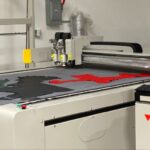
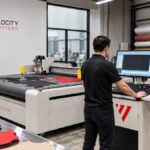
The Velocity ProCut-X Single Ply Cutter is a digital cutting system designed to process single-layer materials with precision, speed, and reliability. This type of solution is particularly useful for upholstery, custom orders, prototyping, and low- to medium-volume production.
A single-ply cutter can process materials such as:
- fabrics;
- leather;
- vinyl;
- foam;
- synthetic materials;
- technical textiles;
- selected composites.
The system includes a conveyor-style worktable that supports continuous materials and long fabric lengths. It can also accommodate different cutting tools to perform contours, holes, straight cuts, notches, and other operations defined in the digital file.
This helps finished components maintain more consistent dimensions across different orders and production batches.
6. Higher Productivity and Shorter Manufacturing Cycles
Automation can reduce time across several production stages:
- pattern creation;
- marker preparation;
- template retrieval;
- manual tracing;
- material positioning;
- cutting;
- reference marking;
- model changeovers.
The benefit does not come only from machine speed. It also comes from reducing repetitive tasks and avoiding interruptions caused by mistakes, corrections, or missing information.
A more connected production workflow can shorten lead times, improve throughput, and make it easier to respond to customized orders.
Manufacturers can use the time saved to expand capacity, accept additional projects, or improve delivery performance.
7. Less Rework During Sewing and Assembly
Cutting errors often become visible during later production stages.
An inaccurate part may result in:
- seams that do not match;
- uneven tension;
- excess or insufficient material;
- distorted corners;
- difficulties covering foam or structural components;
- additional manual trimming;
- complete reproduction of the part.
When the digital file includes contours, notches, marks, and perforations, the cutting system can reproduce those references in consistent positions.
This makes it easier for sewing and assembly personnel to identify where components should align. It also reduces the need to interpret every part manually.
8. Plotters for Patterns, Markers, and Production Documentation
Although digital cutting is an important part of the process, industrial plotters remain useful for printing:
- full-size patterns;
- markers;
- production guides;
- validation pieces;
- technical documentation;
- paper templates.
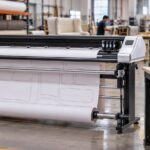
Velocity offers pattern plotters, marker plotters, and combined pattern printing and cutting systems.
The Velocity Tecnica One can support pattern development and pre-production, while the Velocity Vector One, Vector Two, and Vector Four are designed for marker plotting at different production volumes and speeds.
For manufacturers that need to combine pattern printing, perforating, and cutting in a single machine, the Velocity Pattern Plotter Cutter can simplify template preparation.
The appropriate plotter should be selected based on the maximum pattern or marker width, production volume, and compatibility with the existing CAD workflow.
9. Flatbed Solutions for Templates and Specific Materials
Furniture manufacturing may also require cardboard, heavy paper, PVC, plastic panels, and other materials used for samples, templates, or auxiliary components.
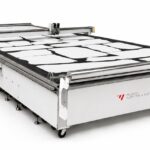
The Velocity Flatbed Plotter Cutter works on a flat surface and is designed to perform plotting and cutting operations in applications such as furniture, upholstery, apparel, and industrial textiles.
A flatbed solution can be used to:
- develop templates;
- create prototypes;
- cut cardboard or semi-rigid materials;
- validate geometries;
- prepare samples;
- manufacture auxiliary components.
The choice between a flatbed system and a conveyor cutter will depend on the material, part dimensions, and continuity required in the production process.
10. Scalable Automation for Workshops and Industrial Plants
Automation is not limited to large manufacturing facilities.
A smaller workshop can begin by digitizing patterns and organizing files with CAD software. It may later add a plotter, a single-ply cutter, or higher-capacity equipment as production demand increases.
For large-volume operations that need to cut multiple layers simultaneously, an automatic multi-ply cutter can provide greater output capacity than a single-ply system.
The main distinction is:
- a single-ply cutter supports flexibility, customization, and frequent design changes;
- a multi-ply cutter supports higher volume and repetitive production.
The selection should be based on the number of parts, materials, frequency of design changes, and expected business growth.
11. Better Production Control and Traceability
When production files are stored digitally, manufacturers can organize information by:
- customer;
- collection;
- model;
- furniture type;
- material;
- version;
- date;
- dimensions;
- approval status.
This makes it easier to identify which pattern was used, what modifications were made, and which version is approved for production.
Traceability reduces the risk of using outdated files or incorrect measurements. It also allows a manufacturer to quickly retrieve a design when a customer requests a replacement or a modified version.
12. More Sustainable Manufacturing Processes
Sustainability in furniture production depends not only on the origin of the materials, but also on how efficiently they are used.
An automated workflow can help:
- reduce offcuts;
- minimize rejected pieces;
- improve the use of material width;
- avoid unnecessary printing or cutting;
- reuse existing patterns;
- reduce rework;
- improve material consumption control.
These benefits can lead to lower operating costs and a more resource-efficient production model.
What Are the Real Benefits of Automation?
Automation for furniture and upholstery can deliver measurable benefits when it is correctly integrated into the workflow.
Greater Accuracy
Patterns and cutting paths are digitally defined, helping reduce variation between parts.
Better Material Utilization
Nesting helps arrange patterns efficiently and reduce unused space.
Fewer Errors
Automation minimizes problems caused by manual tracing, scaling, and interpretation.
Faster Production
Preparation, plotting, marking, and cutting times can be reduced.
More Efficient Customization
Digital files can be modified to produce different measurements and configurations.
Repeatability
An approved pattern can be reproduced consistently across production batches.
Better Control
Files and revisions can be stored, classified, and retrieved more easily.
Scalability
Manufacturers can add new technology as production needs increase.
Which Velocity Solutions Can Be Used for Furniture and Upholstery?
VetiGraph CAD
Supports pattern design, editing, and organization, while also optimizing pattern placement through nesting.
V-Shoot Camera Digitizing System
Converts physical templates into digital files for editing, storage, and production use.
Velocity ProCut-X Single Ply Cutter
Suitable for accurately and flexibly cutting fabrics, leather, vinyl, foam, and other single-layer materials.
Velocity Tecnica One
A pattern plotter for design development, validation, and pre-production tasks.
Velocity Vector One, Two y Four
Marker plotters available in different widths and configurations for various production volumes.
Velocity Pattern Plotter Cutter
Combines pattern printing, perforating, and cutting within a single system.
Velocity Flatbed Plotter Cutter
Performs plotting and cutting operations on a flat table, making it useful for templates, prototypes, and selected materials.
Easy-Plot
Converts CAD files such as DXF and DWG into PLT or HPGL formats for compatible output processes.
How to Choose the Right Automation Solutions
Before implementing automation, manufacturers should evaluate:
- materials being processed;
- maximum part dimensions;
- daily or monthly production volume;
- number of product models;
- frequency of customization;
- CAD formats currently used;
- available floor space;
- required plotting or cutting width;
- cutting and marking operations;
- integration requirements;
- employee skills;
- technical support;
- maintenance and spare parts availability.
Not every company requires the same level of automation.
One operation may begin with digitizing and CAD, while another may need a complete design, nesting, plotting, and cutting workflow from the start.
The decision should be based on the current production process, its main bottlenecks, and the results the company expects to achieve.
After-Sales Service and Spare Parts Availability
Operational continuity becomes especially important when a plotter or cutter becomes a central part of production.
Before purchasing equipment, manufacturers should evaluate:
- availability of technical assistance;
- response times;
- preventive maintenance;
- operator training;
- access to consumables;
- cutting tool availability;
- spare parts inventory;
- software support.
A machine may offer strong technical specifications, but its long-term value also depends on the support available after installation.
Reliable service and spare parts availability help reduce the risk of extended downtime and protect the investment throughout the equipment’s useful life.
Conclusion
Automation for furniture and upholstery offers benefits that go beyond faster production.
A digital workflow can improve pattern accuracy, reduce variation, make better use of materials, and simplify the production of customized products. It can also preserve technical knowledge, improve version control, and connect design, preparation, plotting, and cutting.
Velocity Plotters & Cutters provides an ecosystem that includes VetiGraph CAD, V-Shoot, pattern and marker plotters, the ProCut-X single-ply cutter, multi-ply cutting systems, flatbed equipment, and file conversion tools. These solutions can be combined according to the production characteristics and automation level of each manufacturer.
To achieve meaningful results, automation should be implemented after evaluating materials, patterns, production volume, workflows, and business objectives. The best solution is not necessarily the largest or fastest machine, but the one that addresses the most important production bottlenecks and can support the company’s future growth.

 EN_US
EN_US  ES
ES