
Introduction
In the apparel, footwear, upholstery, automotive interiors, and technical textiles industries, cutting is a critical stage for ensuring precision, productivity, and material efficiency. That is why, when companies look to automate this part of the process, one key question often comes up: is a single ply cutter or a multi ply cutter the better choice? The answer depends on the type of operation, production volume, materials being used, and the level of automation the business wants to achieve.
Although both solutions are designed for automated cutting, their applications and advantages serve different operational needs. Understanding those differences helps companies make better investment decisions and choose the right technology based on their actual production environment.
Velocity Plotters & Cutters offers specialized solutions for both scenarios. On one side, it offers the Velocity ProCut-X Single Ply Cutter, designed for precise cutting of single-layer materials. On the other, it offers the Automatic Multi-Ply Cutter, a high-capacity system built for large-scale manufacturing environments.
What Is a Single Ply Cutter?
A single ply cutter is a digital cutting system designed to process materials arranged in a single layer. This type of solution stands out for its precision, flexibility, and ability to handle individual pieces or production runs that require a higher degree of control in every cut.
Single ply cutters are often ideal for operations that need:
- high precision;
- frequent design changes;
- customization;
- product development;
- lower-volume production runs;
- work with delicate or technical materials.
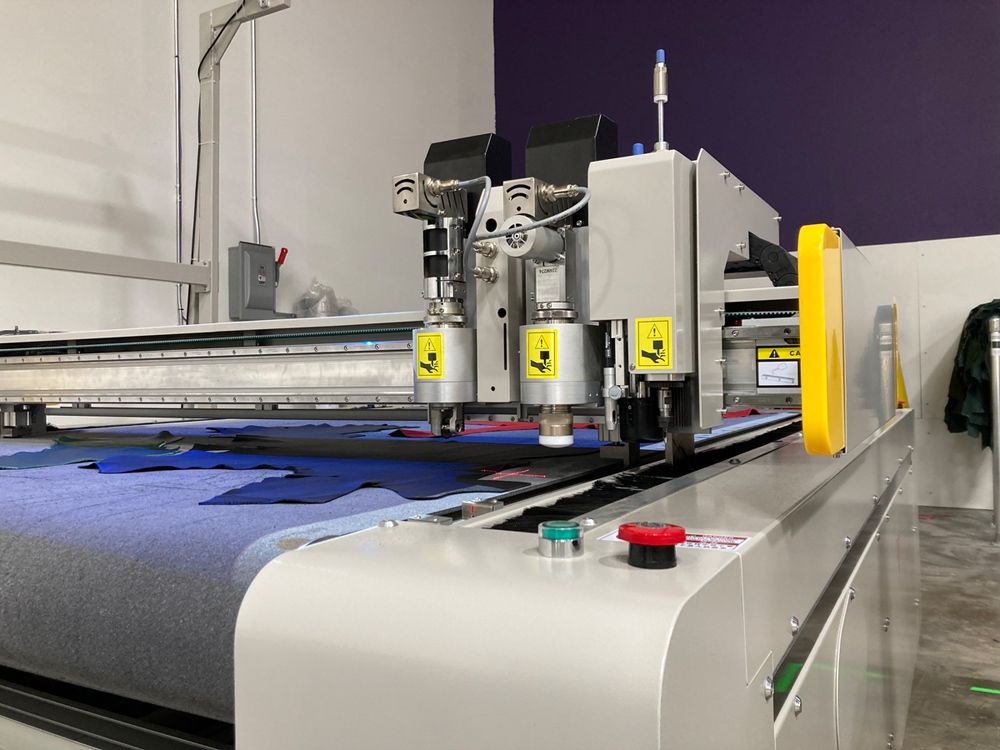
Within the Velocity Plotters & Cutters portfolio, the solution for this need is the Velocity ProCut-X Single Ply Cutter, described as an advanced digital cutting system that delivers superior precision, high speed, and reliability when cutting single-layer materials. Based on the company overview, this solution is well suited for custom apparel, footwear, automotive interiors, PPE, and technical textiles, helping businesses optimize cutting, minimize waste, and maximize productivity.
It is worth mentioning that this cutter features a conveyor system table designed to handle long lengths of fabric. It also includes a tool head for different cutting tools, allowing it to perform various operations such as holes, straight cuts, notches, among others.
What Is a Multi Ply Cutter?
A multi ply cutter is an automated cutting system designed to process multiple layers of material at the same time. Its main strength is productivity, since it allows businesses to cut larger volumes in less time while maintaining consistency.
This type of solution is usually the best choice for companies operating with:
- continuous production;
- high-volume output;
- repetitive processes;
- scalability needs;
- an industrial efficiency focus;
- stacked material layers to maximize throughput..
In the Velocity Plotters & Cutters offering, the multi-ply solution is the Automatic Multi-Ply Cutter, described as a next-generation high-capacity cutting system designed to meet the demands of large-scale manufacturing. According to the information provided, it integrates intelligent automation and Industry 4.0 technologies to deliver precision, speed, and consistency across a wide range of materials, from lightweight fabrics to dense textiles such as denim, Kevlar, and other technical materials.
Key Differences Between a Single Ply Cutter and a Multi Ply Cutter
Although both solutions are built to automate cutting and improve efficiency, there are important differences to consider before making a decision.
1. Production Volume
This is one of the most important differences.
- A single ply cutter is better suited for low- to medium-volume operations, flexible production, sample development, or customization.
- A multi ply cutter is designed for high-volume operations where the goal is to process large quantities of material quickly and consistently.
If a company needs to cut large numbers of repetitive pieces in less time, a multi-ply cutter usually has a clear advantage. If the operation requires faster adaptation to design changes and more specialized work, a single ply cutter may be the better option.
2. Type of Operation
A single ply cutter is often a better fit for operations where variety is high and adaptability is essential. For example:
- custom apparel manufacturing;
- product development;
- prototypes;
- short production runs;
- special materials.
A multi ply cutter, by contrast, is better suited for more structured operations with a high level of repetition, such as:
- mass garment production;
- continuous industrial manufacturing;
- large-scale cutting;
- plants with high daily output demands.
3. Precision and Control
Both types of cutters can deliver high precision, but the single ply cutter tends to stand out when detailed control over each individual piece is especially important. Since it works with one layer at a time, it allows for fine adjustments and precise execution on materials that require more care.
The multi ply cutter also offers precision, but its greatest strength is maintaining consistency and throughput when handling large-scale cutting across multiple layers.
4. Time Efficiency and Productivity
A multi ply cutter offers a clear productivity advantage when a company works with high volumes, since it cuts multiple layers at once and significantly speeds up production.
A single ply cutter, on the other hand, can be more efficient in operations where changes happen frequently and the priority is not only output volume, but also flexibility and responsiveness.
5. Type of Materials
The choice also depends on the materials the company works with.
The Velocity ProCut-X Single Ply Cutter is aimed at sectors such as custom apparel, footwear, automotive interiors, PPE, and technical textiles, making it a strong solution for operations that require precision on specific or higher-value materials.
The Automatic Multi-Ply Cutter, meanwhile, is designed to handle a wide variety of materials, including lightweight fabrics and high-density textiles such as denim, Kevlar, and other technical fabrics, making it especially powerful for higher-capacity industrial environments.
When Does a Single Ply Cutter Make More Sense?
A single ply cutter is usually the best option when a company needs a balance between automation, precision, and flexibility. It is especially recommended for operations that:
- handle custom orders;
- develop samples or prototypes;
- make frequent design changes;
- work with technical or delicate materials;
- need high-accuracy cutting on a single layer;
- want to modernize the process without depending on very large volumes.
In these cases, the Velocity ProCut-X Single Ply Cutter represents a strong solution because it combines precision, speed, and reliability for single-layer materials, helping reduce waste and improve productivity.
When Does a Multi Ply Cutter Make More Sense?
A multi ply cutter is more convenient when the priority is volume, speed, and efficiency at scale. It is ideal for companies that:
- produce in large quantities;
- need to optimize cutting time;
- want greater daily capacity;
- work with repetitive production processes;
- require robust industrial automation;
- want to integrate more advanced manufacturing technologies.
In this scenario, the Automatic Multi-Ply Cutter is a strong alternative within the Velocity portfolio, since it is specifically designed for large-scale manufacturing and offers an intelligent automation and Industry 4.0 approach.
Which One Is Better for Your Operation?
The answer depends on how your company works today and where it wants to grow.
A single ply cutter may be the right choice if:
- your operation is flexible;
- you handle small or medium batches;
- you focus on product development;
- you need precision on each piece;
- you work with specialized materials;
- you need to adapt quickly to design changes.
A multi ply cutter may be the better fit if:
- your production is continuous;
- you handle high volumes;
- you need more output in less time;
- you want to reduce operational cutting time;
- your business is already geared toward industrial scale;
- you want to strengthen plant automation.
In many cases, the decision should not be based only on current volume, but also on growth projections. A company that currently works at medium scale may need greater cutting capacity in the near future. That is why evaluating the operation from a strategic perspective is essential.
Beyond Cutting: A More Integrated Vision for the Industry
Automated cutting creates even more value when it is integrated with other workflow solutions. Velocity Plotters & Cutters does not only offer cutting systems. It also provides complementary tools that connect design, pattern development, digitizing, and production preparation.
These solutions include:
- Velocity Plotters for patterns, markers, and combined printing and cutting systems;
- V-Shoot, a camera-based digitizing system that converts physical patterns into digital files compatible with CAD software;
- VetiGraph CAD, a CAD suite built to improve productivity and technical accuracy;
- Easy-Plot, a CAD file conversion solution for plotter-ready output.
This allows companies to build a more connected and efficient ecosystem from design to final cutting.
Conclusion
Choosing between a single ply cutter and a multi ply cutter does not depend on which one is better in absolute terms, but on which one best fits the type of operation, production volume, materials used, and growth objectives of the business.
The Velocity ProCut-X Single Ply Cutter is an ideal solution for operations that require precision, flexibility, and control over single-layer materials. The Automatic Multi-Ply Cutter, by contrast, delivers the capacity, speed, and automation needed for large-scale industrial operations.
For companies looking to improve competitiveness, reduce waste, and optimize cutting processes, having the right technology can make a decisive difference in both productivity and profitability.




 EN_US
EN_US  ES
ES