
What Is an Apparel Plotter?
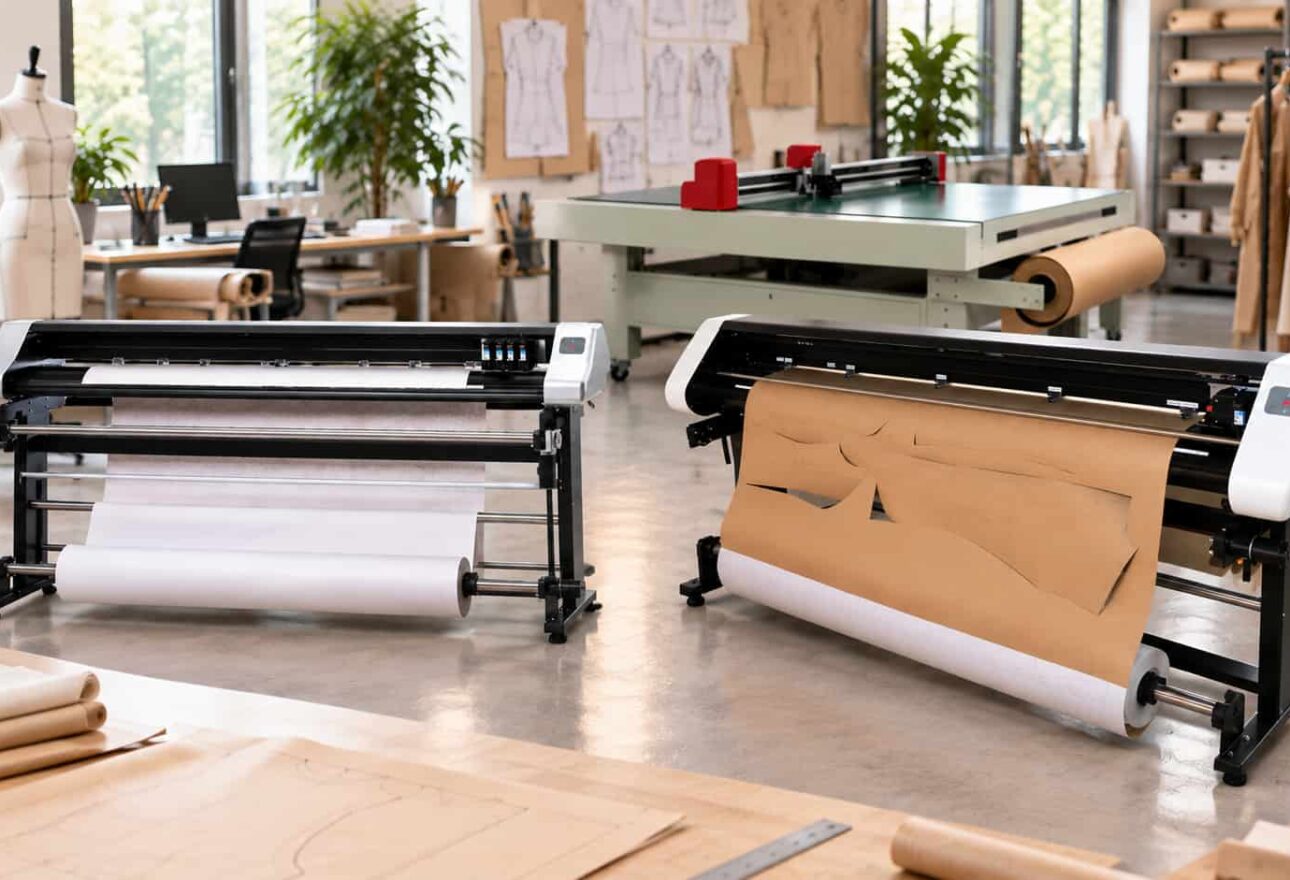
An apparel plotter is a wide-format industrial plotting system used to print full-scale garment patterns and nested markers generated by apparel CAD software.
Unlike conventional office or graphic-design printers, apparel plotters are designed around the workflow of pattern making, grading, marker making, sample development, and production cutting.
Typical applications include:
– Apparel and garment manufacturing
– Fashion design
– Pattern making
– Sample rooms
– Cut-and-sew operations
– Uniform manufacturing
– Sportswear
– Workwear
– Technical sewn products
– Contract sewing
– Textile manufacturing
Depending on the application, manufacturers may need a pattern plotter, marker plotter, plotter/cutter, or automated fabric cutting system.
What Should You Look for in an Apparel Plotter?
There is no single machine configuration that is ideal for every apparel manufacturer. The best plotter is the one properly matched to the company’s production requirements.
Here are some of the most important factors to consider.
1. Plotting Width
One of the first questions to ask is:
What is the widest marker or pattern file we regularly need to print?
Buying a plotter that is too narrow can restrict production. At the same time, purchasing substantially more width than your operation requires may not provide a meaningful benefit.
Two common industrial marker plotting widths are approximately:
66 inches y 72 pulgadas
For companies whose markers remain within approximately 66 inches, a 66-inch plotting system can be an efficient choice.
Operations regularly producing wider markers should consider a 72-inch system.
Always evaluate the actual maximum plotting width, rather than simply the width of paper that can physically be loaded into the machine.
2. Production Volume and Plotting Speed
A small fashion studio producing a limited number of markers each week has very different requirements from a high-volume apparel manufacturer operating throughout the day.
Velocity offers configurations designed for different production requirements.
The Vector One uses a single plotting head and is designed for companies that require industrial marker plotting without the production requirements of a higher-speed multi-head system.
The Vector Two incorporates two plotting heads to increase plotting productivity and is better suited for operations producing larger quantities of markers.
For higher-production environments, a four-head configuration can provide additional plotting capacity.
The important question isn’t simply:
“Which plotter is fastest?”
The better question is:
“How much plotting capacity does my company actually need?”
Selecting equipment based on real production volume can prevent both under-capacity and unnecessary capital expenditure.
3. CAD and File Compatibility
CAD compatibility should be evaluated before purchasing any apparel plotter.
Apparel manufacturers commonly work with systems and file formats associated with platforms such as Gerber AccuMark, Lectra, Optitex, Tukatech, StyleCAD, PAD System, VetiGraph, AutoCAD, and other CAD/CAM environments.
Common plotting formats can include:
– PLT
– HPGL
– HPG
Other workflows may originate from:
– DXF
– AAMA DXF
– DWG
When a CAD system does not directly generate the plotting format required by the machine, conversion software can become part of the workflow.
Velocity’s EasyPlot solution, for example, can be used in workflows where CAD files such as DXF need to be converted into a plotting-compatible format.
Before purchasing any plotter, manufacturers should confirm the complete workflow:
CAD Software → Exported File → Conversion, if required → Plotter
Do not assume compatibility simply because two systems both support a format with the same extension. Testing representative production files before implementation is always recommended.
4. Paper Requirements
Paper selection affects plotting reliability, handling, and operating cost.
Apparel marker plotters commonly use wide-format bond or specialized marker paper.
Although lighter paper may be usable in certain applications, heavier bond paper can provide better durability and may reduce tearing during handling.
Manufacturers should evaluate:
– Paper weight
– Roll width
– Core diameter
– Roll length
– Paper availability
– Cost per roll
– Handling requirements
– Take-up requirements
Paper is a recurring operating expense, so it should be considered when calculating the total cost of ownership.
5. Connectivity and Workflow
Modern apparel production environments frequently need multiple workstations to access the same plotting equipment.
Depending on the model and configuration, network connectivity can allow the plotter to become part of the production workflow rather than requiring files to be manually transferred from computer to computer.
Before purchasing, determine whether your company requires:
– USB connectivity
– LAN/network connectivity
– Multiple CAD workstations
– Dedicated plotter workstation
– Remote technical support
– File conversion software
A properly planned workflow can be just as important as the hardware itself.
Best Velocity Plotters for Apparel Manufacturing in 2026
Different apparel operations require different equipment. The following Velocity systems are designed for distinct production requirements.
Velocity Vector 1600 Series — Best for Up to 66-Inch Marker Plotting
For apparel manufacturers whose production markers do not exceed approximately 66 inches of plotting width, the Velocity Vector 1600 series provides an industrial marker plotting solution without requiring the additional width of a 72-inch machine.
Configurations include:
Vector One 1600
Single-head configuration for lower to moderate plotting requirements.
Vector Two 1600
Dual-head configuration for companies requiring greater plotting productivity.
The appropriate configuration depends primarily on production volume rather than width alone.
Best suited for:
– Apparel manufacturers
– Fashion companies
– Cut-and-sew operations
– Pattern departments
– Sample rooms
– Uniform manufacturers
– Contract sewing facilities
– Companies producing markers up to 66 inches wide
Velocity Vector 1800 Series — Best for Up to 72-Inch Marker Plotting
Manufacturers requiring additional plotting width should consider the Velocity Vector 1800 series.
With plotting capability up to approximately 72 inches, the Vector 1800 is designed for wider production markers and companies that want additional width capacity.
Depending on production requirements, configurations can include single-head and multi-head options.
Best suited for:
– Apparel manufacturers producing wider markers
– High-volume production facilities
– Large pattern departments
– Industrial textile operations
– Companies requiring up to approximately 72 inches of plotting width
The decision between a Vector 1600 and Vector 1800 should therefore begin with one simple measurement:
What is the widest marker your company actually produces?
Velocity Tecnica One — Best for Smaller Pattern-Making Requirements
Not every apparel business needs a 66-inch or 72-inch industrial marker plotter.
Fashion designers, educational programs, pattern makers, sample rooms, and smaller apparel businesses may primarily work with individual pattern pieces rather than large nested production markers.
For these applications, a smaller-format pattern plotting solution such as the Velocity Tecnica One may be more appropriate.
Rather than purchasing equipment based solely on maximum width, smaller operations should evaluate their actual pattern dimensions and weekly plotting volume.
Velocity Futura Pattern Plotter Cutter — Best When Plotting and Pattern Cutting Are Both Needed
Some apparel operations need more than printing.
Pattern departments may need to produce physical pattern pieces that subsequently need to be cut from paper.
For these workflows, a pattern plotter/cutter can combine plotting and cutting functions within the same equipment platform.
The Velocity Futura Pattern Plotter Cutter is designed for applications requiring both functions.
This can be particularly useful for:
– Pattern departments
– Sample development
– Fashion design
– Pattern modification
– Short-run pattern production
– Development departments
It is important to distinguish a paper pattern plotter/cutter from an automatic fabric cutting system. They perform different production functions.
What About Cutting Fabric Automatically?
A marker plotter prints the marker that guides the cutting process.
An automatic cutter goes significantly further by cutting the material itself.
Apparel manufacturers looking to automate single-ply cutting should evaluate equipment such as the Velocity ProCut X Single-Ply Cutter rather than a conventional marker plotter.
This creates a broader digital production workflow:
CAD Pattern → Marker/Nesting → Plotting or Digital File → Automated Cutting → Sewing/Assembly
The appropriate level of automation depends on production volume, materials, labor costs, throughput requirements, and return on investment.
66-Inch vs. 72-Inch Apparel Plotter: Which Should You Buy?
This is one of the most common decisions apparel manufacturers face.
Choose a 66-inch plotter when your production markers consistently remain within that plotting width and there is no foreseeable requirement for wider markers.
Consider a 72-inch plotter when you regularly produce wider markers or want additional width capacity for future applications.
Do not make the decision based only on paper roll width.
The critical specification is the machine’s maximum usable plotting width.
Single-Head vs. Multi-Head Plotter
The next major consideration is production speed.
Generally appropriate for:
– Lower plotting volume
– Smaller manufacturers
– Sample rooms
– Development departments
– Companies producing a limited number of markers each week
Generally appropriate for:
– Medium-to-higher plotting volume
– Production environments
– Companies requiring faster marker output
– Multiple CAD operators sharing plotting capacity
Potentially appropriate for:
– High-volume production
– Facilities where plotting throughput is critical
– Operations producing substantial marker volume
The most expensive or fastest configuration isn’t automatically the best choice.
The objective should be to purchase sufficient production capacity for current requirements while allowing reasonable room for growth.
Windows 11 and Computer Compatibility
Operating-system compatibility should be confirmed before purchasing industrial equipment.
Velocity plotting workflows can support Windows-based production environments, including appropriately configured Windows 11 systems, depending on the software and hardware configuration.
Companies using Apple Mac computers should carefully evaluate the complete workflow before purchasing.
If a CAD environment is running on macOS, a dedicated Windows computer or networked Windows workstation may sometimes provide a more straightforward production environment than relying on virtualization.
Always verify the intended computer, CAD software, conversion software, drivers, and plotter configuration before implementation.
Should an Apparel Plotter Require a Mandatory Service Contract?
Service requirements can substantially affect the long-term cost of industrial equipment.
When comparing plotters, buyers should ask:
– Is an annual service contract mandatory?
– What happens when the warranty expires?
– Can replacement parts be purchased independently?
– Is technical support available without an annual contract?
– Are software upgrades mandatory?
– Does the customer own the equipment?
– What software licenses are included?
– What are the costs of post-warranty technical support?
En Velocity Plotters & Cutters, service agreements are not designed to be mandatory simply because a customer owns a machine.
Customers can evaluate optional support and service arrangements according to their operational requirements.
This distinction should be considered when comparing the total cost of ownership of competing industrial plotting systems.
How Much Does an Apparel Plotter Cost?
Pricing depends on several factors, including:
– Plotting width
– Number of plotting heads
– Plotting versus plotting/cutting capability
– Software requirements
– Shipping destination
– Installation requirements
– Training
– Accessories
– Warranty and support configuration
For this reason, manufacturers should compare more than the initial equipment price.
A better comparison is:
Purchase Price + Software + Installation + Freight + Consumables + Maintenance + Support + Expected Service Costs = Total Cost of Ownership
A machine with a lower purchase price isn’t necessarily less expensive over five or ten years.
Likewise, a more expensive machine isn’t automatically a better investment.
Questions to Ask Before Buying an Apparel Plotter
Before requesting a quotation, answer these questions:
- What is the maximum width of our markers?
- How many markers do we plot per day or week?
- Which CAD software do we use?
- What file formats does our CAD system export?
- Do we need plotting only or plotting and cutting?
- Do we eventually want automatic fabric cutting?
- What type and weight of paper do we currently use?
- Do we need network connectivity?
- How many users will send files to the plotter?
- What level of technical support do we require?
- What warranty is included?
- Is an annual service contract mandatory?
- Are replacement parts readily available?
- What are the expected annual operating costs?
- Do we anticipate requiring greater width or production capacity in the future?
Answering these questions before selecting a model can prevent an expensive mismatch between the equipment and the actual production requirement.
Preguntas Frecuentes
What is the best plotter for apparel manufacturing?
There is no single best plotter for every apparel manufacturer. The appropriate machine depends on plotting width, marker volume, CAD workflow, paper requirements, production speed, support requirements, and budget.
For operations requiring up to approximately 66 inches of marker plotting width, the Velocity Vector 1600 series is one option to consider. Companies requiring up to approximately 72 inches should evaluate the Velocity Vector 1800 series.
What size plotter do I need for apparel markers?
Measure the widest markers your company currently produces and consider realistic future requirements.
If your maximum marker width remains within approximately 66 inches, a 66-inch plotting system may be sufficient. Wider applications may require a 72-inch system.
Can an apparel plotter print DXF files?
DXF is primarily a CAD exchange format rather than a native plotting language for many industrial plotters.
A common workflow is:
DXF → Conversion Software → PLT/HPGL → Plotter
Velocity EasyPlot can be incorporated into workflows requiring file conversion. Compatibility should always be verified using representative production files.
What is the difference between a pattern plotter and a marker plotter?
A pattern plotter is commonly used for individual full-scale pattern pieces, while a marker plotter is designed to print wider nested production markers containing multiple pattern pieces arranged for material utilization.
The correct system depends on whether the operation is primarily developing individual patterns or producing markers for production cutting.
Do I need a plotter/cutter?
If you only need to print markers, probably not.
If your pattern department needs to print individual paper patterns and automatically cut those patterns, a pattern plotter/cutter may improve the workflow.
If the objective is to cut fabric automatically, an automated cutting system should be evaluated instead.
Which Velocity Plotter Is Right for Your Apparel Business?
A simplified starting point is:
| Production Requirement | Velocity Solution |
|---|---|
|
Smaller individual pattern plotting |
Tecnica One |
|
Up to 66″ marker plotting |
Vector 1600 |
|
Up to 72″ marker plotting |
Vector 1800 |
|
Increased marker plotting productivity |
Vector Two / multi-head configuration |
|
High-volume marker plotting |
Vector Four configuration where applicable |
|
Paper pattern plotting + cutting |
Futura Pattern Plotter Cutter |
|
Automated single-ply material cutting |
ProCut X |
|
Pattern digitizing |
V-Shoot |
|
CAD/file conversion |
EasyPlot |
The final selection should always be based on the manufacturer’s actual production requirements.
Final Recommendation
The best apparel plotter for 2026 isn’t necessarily the widest, fastest, or most expensive machine.
It is the plotter that best matches your:
Marker width + Production volume + CAD workflow + Required speed + Support requirements + Budget + Future growth
For a small pattern department, that may mean a compact pattern plotter.
For an apparel manufacturer producing markers up to 66 inches, a Velocity Vector 1600 may be an appropriate solution.
For wider markers, a Velocity Vector 1800 may provide the required additional capacity.
For companies needing physical paper patterns to be both plotted and cut, a Velocity Futura Pattern Plotter Cutter may provide a better workflow.
And manufacturers moving toward automated fabric cutting should evaluate a dedicated system such as the Velocity ProCut X.
The key is not buying more equipment than you need—or discovering after installation that you purchased too little.
Talk to Velocity Plotters & Cutters
Before recommending a machine, Velocity can evaluate your existing production workflow.
Be prepared to provide:
– Maximum marker width
– CAD software
– Typical file format
– Approximate number of markers produced per week
– Paper type
– Current plotting equipment, if applicable
– Shipping destination
Based on those requirements, the appropriate plotter configuration can be identified before a formal quotation is prepared.
Velocity Plotters & Cutters
Industrial Pattern Plotters • Marker Plotters • Pattern Plotter Cutters • Automated Cutting Systems • Pattern Digitizing • CAD/CAM Solutions
¿Te ha gustado el artículo? Síguenos para obtener más información y actualizaciones.




 ES
ES  EN_US
EN_US