
Tabla de Contenidos
- What Makes Industrial Cutting Machines Essential for Leather Upholstery
- Key Features to Evaluate in Industrial Cutting Machines
- Automating Leather Cutting for Small Factories
- Reducing Leather Waste in Furniture Manufacturing
- Digital Flatbed Cutter for Leather: Mechanical vs. Laser Options
- Maintenance, Durability, and Long-Term ROI
- Preguntas Frecuentes
Last Updated: September 21, 2026
What Makes Industrial Cutting Machines Essential for Leather Upholstery
The difference between a profitable upholstery operation and one that hemorrhages material waste comes down to one thing: precision at scale. When you’re cutting leather for furniture production, every wasted inch compounds across thousands of units. A machine that cuts with accuracy reduces scrap. A machine that automates the process frees your team to handle more complex work. The best industrial cutting machines for leather upholstery do both simultaneously.
Industrial cutting machines transform how furniture and upholstery manufacturers approach production. They replace manual pattern cutting with automated systems that follow digital designs with millimeter precision. This matters because leather is expensive. A 5% reduction in waste translates directly to margin improvement. For a mid-sized upholstery shop, that’s the difference between breaking even and building profit.
The challenge isn’t finding a cutting machine. It’s finding one that matches your actual workflow, material types, and production volume. Many operations start by automating one step and discover they’ve created bottlenecks elsewhere.
Key Features to Evaluate in Industrial Cutting Machines
Not every cutting machine performs the same. The machines that deliver real value share specific characteristics that most buyers overlook until they’re already committed to a purchase.
Material Thickness and Cutting Capacity
Leather varies dramatically in thickness and density. Garment leather runs thin, around 0.5mm to 1mm. Upholstery leather for furniture is heavier, typically 1.5mm to 3mm. Heavy-duty work, automotive interior panels, marine seating, demands machines that cut through 4mm or thicker without degrading the edges or requiring multiple passes.
Precision and Stitch Consistency
Precision cutting determines whether seams align properly downstream. If your cutter deviates by 2mm, your sewing operator discovers the problem when two pieces don’t fit together. That’s rework, which kills productivity.
Production Speed and Workflow Integration
Speed matters only if it doesn’t sacrifice quality. A cutter that produces 50 pieces per hour but requires constant adjustments is slower than one running at 40 pieces per hour with zero intervention.
Automating Leather Cutting for Small Factories
Small operations face a specific problem: they can’t justify the capital cost of full automation, but they’re losing money to manual cutting inefficiency. The answer isn’t a massive industrial system. It’s a machine that automates the cutting process while remaining affordable and simple to operate.
Workflow Integration and Software Compatibility
The walking foot mechanism is essential for small-shop automation. This mechanism feeds material consistently through the cutting path, eliminating the need for operators to manually guide leather. The result is faster cutting, fewer operator errors, and reduced fatigue on your team. For a 15-person cutting room, this difference can significantly impact daily production.
Common integration points include:
- Direct CAD import: The machine accepts .ai, .pdf, or .dxf files without intermediate software
- Nesting software: Built-in or compatible nesting tools that arrange patterns across the hide to minimize waste
- Material library: Pre-loaded settings for common leather thicknesses and densities so operators don’t recalibrate for each job
- Job queuing: The ability to load multiple patterns and run them sequentially without manual intervention
Training Time and Operator Adoption
Training time directly impacts adoption and ROI. A machine that requires weeks of technical training will sit idle while your team resists the change. The best industrial cutting machines for leather upholstery operate intuitively. Your pattern makers should be able to load a design and start cutting within a day.
Realistic training expectations:
- Day 1: Basic operation, material loading, and running a pre-loaded pattern (2-3 hours)
- Day 2-3: Creating custom patterns, adjusting blade pressure for different leather grades, troubleshooting common issues (4-6 hours)
- Week 2: Optimization, nesting patterns efficiently, managing material waste, integrating with your existing production schedule (ongoing)
Reducing Leather Waste in Furniture Manufacturing
Waste reduction is where industrial cutting machines deliver measurable financial impact. Leather costs money. Every scrap that falls to the floor is money you’re throwing away. A typical furniture manufacturer can experience significant material waste in manual cutting operations.
Digital Flatbed Cutter for Leather: Mechanical vs. Laser Options
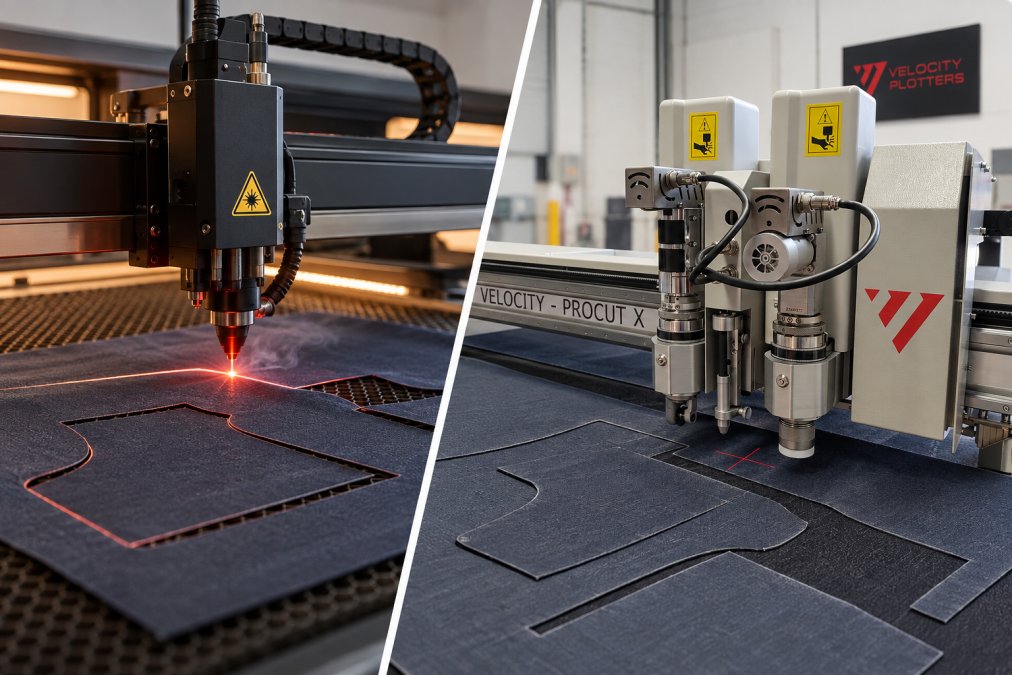
Two primary technologies dominate industrial leather cutting: mechanical oscillating knife cutters and laser systems. Each solves different problems.
Oscillating Knife Cutters for Heavy-Duty Work
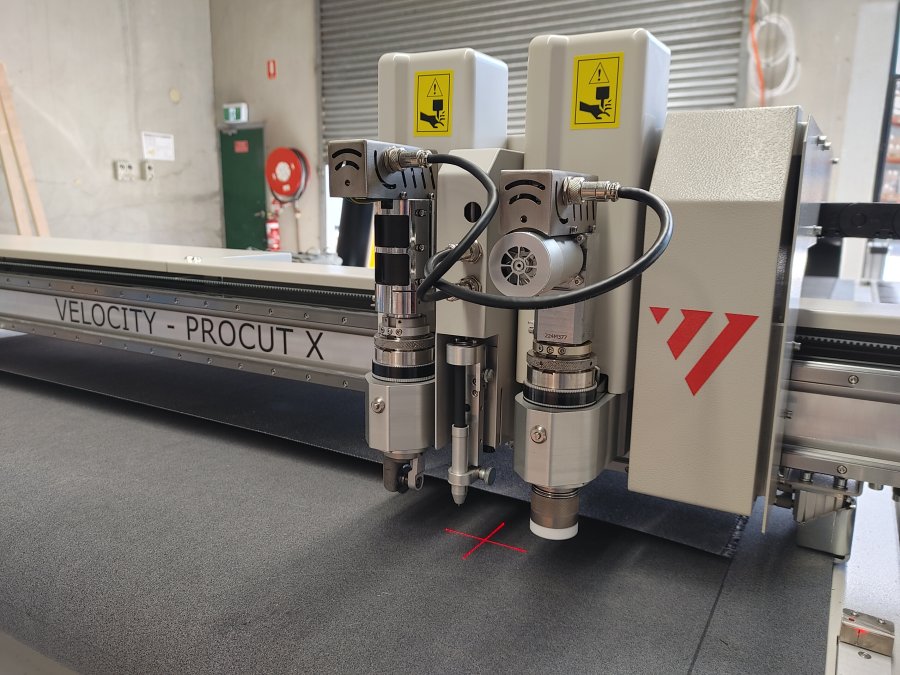
Mechanical oscillating knife cutters use a blade that moves up and down at high frequency while the cutting head traverses the material. This approach works for nearly any leather thickness and density. The blade simply cuts through whatever is underneath.
Laser Engraving and Precision Cutting
Laser cutters use a focused beam to burn through material. For leather, this approach offers exceptional precision and minimal material waste. The laser cuts only where the beam touches, leaving zero kerf (waste from the cut itself).
Maintenance, Durability, and Long-Term ROI
A cutting machine is only valuable if it runs reliably. The most precise cutter in the world is worthless if it’s broken half the time. Long-term ROI depends on three factors: component durability, maintenance cost predictability, and workspace readiness.
Component Quality and Reliability
Industrial machines designed for continuous operation use heavy-duty components. Servo motors maintain consistent torque across production runs. Precision bearings handle thousands of daily cutting cycles without degradation. The frame construction accounts for the forces generated by cutting, with minimal flex or vibration.
When comparing machines, examine these durability indicators:
- Frame construction: Welded steel or cast iron with minimal flex under cutting load (test by pressing on the cutting bed, it should move less than 0.5mm)
- Bearing specifications: Industrial-grade sealed bearings rated for continuous duty, not hobby-grade components
- Motor type: Servo motors with encoder feedback maintain precision; clutch motors are cheaper but drift over time
- Blade drive system: Direct-drive systems are more reliable than belt-driven systems, which slip and require periodic tensioning
Maintenance Schedules and True Operating Costs
Maintenance schedules vary by machine type and directly impact your total cost of ownership. Budget for these costs when evaluating ROI:
Oscillating knife cutters:
- Blade replacement: Every 40-60 hours of operation
- Lubrication: Every 500 hours (minimal cost)
- Bearing inspection: Annually
Servo-driven systems:
- Calibration checks: Every 1,000 hours or quarterly, whichever comes first
- Encoder cleaning: Every 500 hours (prevents drift)
- Motor brushes (if applicable): Every 2,000 hours
Laser systems:
- Laser tube replacement: Every 2-5 years
- Optics cleaning: Monthly (mirrors and lenses degrade with dust)
- Cooling system maintenance: Every 500 hours (critical; failure ruins the tube)
Workspace Requirements: Noise, Ventilation, and Electrical Infrastructure
This is where many small factories get blindsided. Industrial cutting machines aren’t quiet, and they require specific workspace conditions that most facilities don’t initially have.
Noise levels:
- Oscillating knife cutters: 85-95 decibels (equivalent to a lawn mower)
- Servo-driven systems: 75-85 decibels
- Laser systems: 70-80 decibels
Ventilation requirements:
- Oscillating knife cutters: Minimal ventilation (no fumes)
- Laser systems: Significant ventilation required (burning leather produces smoke and odor; OSHA requires extraction systems that remove 200-400 cubic feet per minute)
- Dust collection: All systems benefit from dust collection to prevent material buildup on the cutting bed, which degrades accuracy
Electrical infrastructure:
- Single-phase systems: 110V or 220V, standard in most facilities
- Three-phase systems: Require 208V or 480V service; if your facility doesn’t have three-phase power, installation can be a significant cost.
- Power draw: Industrial cutters draw 5-15 amps continuously; verify your electrical panel has available capacity
Evaluating Used and Refurbished Equipment
High-quality industrial machines are expensive. High-quality industrial machines are expensive. Used and refurbished equipment can cost less, but inspection is critical. Many small factories successfully operate used machines; others inherit expensive problems.
Red flags when inspecting used equipment:
- Visible rust or corrosion on the frame (indicates poor storage or maintenance)
- Loose or rattling components when the machine runs (worn bearings)
- Inconsistent cutting depth across the bed (frame flex or blade wear)
- Burnt smell from the motor (overheating or electrical issues)
- Missing or illegible serial numbers (stolen or salvaged equipment)
- No maintenance records (you have no idea what’s been replaced or when)
Green flags:
- Complete maintenance records showing regular blade replacement and calibration
- Original documentation and parts lists
- Seller willing to demonstrate the machine cutting your actual material
- Consistent cutting quality across multiple test cuts
- Recent blade replacement (shows the seller maintained it)
ROI Calculation and Payback Timeline
ROI calculation is straightforward but requires honest assumptions. A machine that reduces waste by 10% and increases output by 15% through faster cutting generates measurable financial return.
Example for a 15-person cutting room:
- Current waste rate: 12% of material cost
- Leather cost: $15 per square foot
- Monthly material usage: 2,000 square feet
- Current monthly waste cost: $3,600
- Projected waste reduction with automation: 8% (down to 4% waste rate)
- Monthly savings: $1,800
- Machine cost: $35,000
- Payback period: ~19 months
Preguntas Frecuentes
What is the best type of machine for cutting thick leather upholstery?
Oscillating knife cutters are the best choice for thick leather upholstery because they handle material thickness up to 0.5 inches without sacrificing precision. Heavy-duty machines with servo motors and adjustable presser foot tension deliver consistent needle penetration and seam strength. For upholstery-grade leather, ensure the machine has a walking foot mechanism to prevent material slippage during cutting and maintains thread tension stability throughout production runs.
How do I reduce material waste when cutting leather upholstery?
Reducing leather waste starts with optimized nesting software that maximizes material feed efficiency on your cutting bed. Automated systems with precision cutting capabilities can significantly reduce waste compared to manual methods. Implement a calibration schedule to maintain cutting accuracy, use vacuum table technology to stabilize material during cuts, and train operators on proper material placement. Digital design-to-production workflows ensure patterns are optimized before cutting begins.
Can digital flatbed cutters handle genuine leather for furniture?
Yes, digital flatbed cutters designed for industrial output can handle genuine leather for furniture applications. Look for machines with adjustable cutting pressure, servo motor control, and a work surface that supports the material weight. Genuine leather requires careful calibration of blade depth and cutting speed to prevent over-cutting or damage. CNC knife cutters with software compatibility for CAD files allow you to cut complex patterns with repeatability and accuracy essential for furniture production.
What’s the difference between laser cutting and mechanical cutting for leather?
Mechanical cutting with oscillating knives is effective for thick, heavy-duty leather and high-volume production, handling material thickness consistently and producing clean seams. Laser engraving works well for thin leather and decorative detailing. For upholstery, mechanical cutters with servo motors and walking foot mechanisms can provide durability and production efficiency. Choose based on your material thickness, production volume, and whether you need both cutting and engraving capabilities.
 ES
ES  EN_US
EN_US