
Tabla de Contenidos
- Step 1: Measure Your Current Fabric Waste Baseline
- Step 2: Improve Marker Efficiency in Apparel Manufacturing
- Step 3: Adopt Automated Cutting Room Solutions
- Step 4: Reduce Fabric Waste Through Digital Sampling and Material Selection
- Step 5: Reducing Pre-Consumer Textile Waste on the Floor
- Step 6: Calculate the Financial ROI of Your Waste Reduction Plan
- Common Mistakes That Undo Fabric Waste Reduction
- Preguntas Frecuentes
Last Updated: September 15, 2026
Step 1: Measure Your Current Fabric Waste Baseline
You cannot reduce what you have not measured, and most apparel operations measure fabric waste in the least useful way possible. The first step in reducing fabric waste in apparel production is a baseline that tracks consumption by marker, not monthly invoice totals. This guide walks through the measurement process production managers use to find where yardage disappears.
A common mistake is treating fabric waste as a single number. It is not. It is at least three different problems wearing one coat.
Track Cut-and-Sew Waste by Marker, Not by Month
Monthly waste totals hide everything useful: a marker yielding 82% efficiency and one yielding 94% look identical averaged across 30 days. Track consumption per marker instead, fabric issued, garments cut, and square footage of offcuts for every lay. After two weeks you will see which styles, sizes, and fabric widths underperform, and whether the problem is the pattern, the spread, or the operator.
Separate Pre-Consumer Waste From Scrap You Can Sell
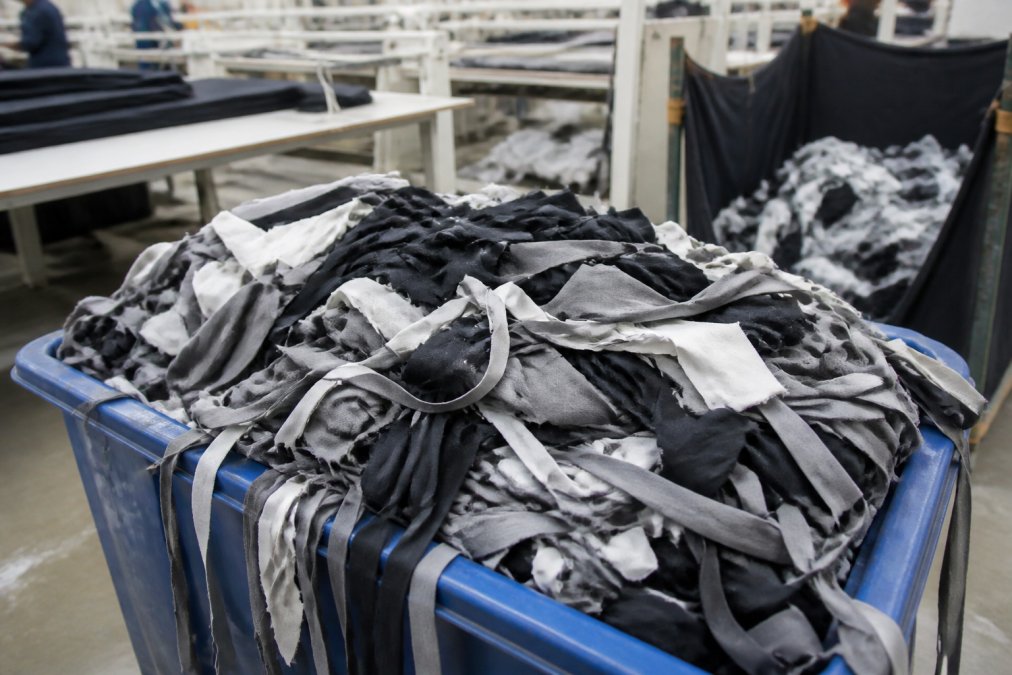
Pre-consumer waste is any material discarded before a garment reaches a customer: cutting-room offcuts, end-of-roll remnants, and rejected panels. Not all of it is trash. Clean, single-fiber offcuts above a usable size can often be sold to recyclers or quilters; contaminated or mixed-fiber scrap cannot. Sorting at the cutting table, not in a dumpster, makes that resale possible, a simple two-bin system (sellable offcuts versus true waste) often changes how the floor treats leftovers within a week.
Weigh your fabric rolls on receipt and again when the roll is retired. That difference, tracked per roll, catches shrinkage, mislabeled yardage, and receiving errors that never show up in marker data.
Step 2: Improve Marker Efficiency in Apparel Manufacturing
Marker efficiency in apparel manufacturing is the percentage of fabric in a marker that ends up in cut garment pieces rather than offcuts. Raising it from the low 80s into the low 90s is the single largest lever most factories have, and it comes down to better pattern nesting and, where the style allows it, zero-waste pattern design.

Pattern Nesting Rules That Cut Yardage
Pattern nesting is the arrangement of pattern pieces on the marker to minimize unused space. Three rules do most of the work. First, rotate pieces to exploit directional grain only where the fabric allows it; on solid, non-napped goods, rotating a sleeve or yoke can recover meaningful yardage. Second, group sizes so larger pieces interlock with smaller ones instead of sitting in their own block.
Zero-Waste Pattern Cutting: A Practical Technical Guide
- Jigsaw tessellation – Design panels that interlock like puzzle pieces across the full width.
- Width-subtraction – Subtract seam allowances and trims from the fabric width first, then design to the remainder.
- Modular panels – Break the garment into repeatable geometric units that tile predictably.
Zero-waste patterns fail when the fabric shrinks or when the spread stretches. Always cut a test lay with the actual production fabric before committing a style to a zero-waste marker.
Step 3: Adopt Automated Cutting Room Solutions
Automated cutting room solutions replace manual spreading and hand cutting with digitally driven spreaders and CNC cutters that follow the marker exactly.
Step 4: Reduce Fabric Waste Through Digital Sampling and Material Selection
Digital sampling replaces physical prototypes with 3D-rendered garments, removing the fabric consumed by sample rounds that never reach production.
Where Sample-Round Fabric Actually Goes
- Fit and drape rounds. 3D rendering resolves silhouette, ease, and drape questions without cutting cloth. This is the highest-yield conversion.
- Colorway and print placement rounds. Digital rendering shows print scale and placement across sizes without printing a single yard.
- Sales and line-review samples. Buyers increasingly accept digital line sheets; the physical sample can be cut only after the order is confirmed.
Track sample yardage as its own line item, separate from production consumption. Most shops have never separated the two, and the sample number is often larger than expected once minimum-order overage is included.
Fabric Width Is a Marker Decision, Not a Sourcing Decision
A few grounded rules:
- Wider is not automatically better. A wider roll reduces the number of marker repeats but can increase end-of-roll remnants if the order quantity does not divide cleanly into the roll length. Run the math per order, not per style.
- Narrow widths punish large sizes. On a narrow roll, the largest size in the grade may not nest efficiently, forcing a separate marker and a separate remnant pool. If your size curve skews large, a wider width often wins even at a higher cost per yard.
- Selvedge and shrinkage eat width before the marker does. Subtract selvedge trim and expected shrinkage from the usable width before you evaluate marker efficiency. A fabric advertised at a given width is not delivering that width to the cutter.
The Trade-Off Nobody States Plainly
3D apparel design and digital product creation resources
Step 5: Reducing Pre-Consumer Textile Waste on the Floor
The cheapest waste to eliminate is the waste you never generate. Fixing a marker once saves fabric on every future run of that style.
Step 6: Calculate the Financial ROI of Your Waste Reduction Plan
This is the section most articles skip, and it decides whether a waste program survives its first quarter.
The Core Formula, Stated Properly
- Waste reduction compounds across every future run of the style. A marker fix is a one-time cost that pays out on every subsequent cut. The correct comparison is one-time cost against recurring annual savings, not against a single order.
- Fabric saved is fabric not purchased, shipped, stored, and disposed of. The avoided cost includes freight, warehousing, and disposal fees, not just the mill invoice.
- Labor and machine time scale with marker efficiency. A tighter marker means fewer lays, fewer spreads, and less cutting time per garment, a second savings stream that most ROI calculations omit entirely.
A defensible per-style calculation looks like this:
- Annual yardage consumed for the style (from your per-marker baseline in Step 1)
- Current marker efficiency (percent)
- Target marker efficiency after the change
- Yardage saved = annual yardage × (1 − current efficiency ÷ target efficiency)
- Annual fabric savings = yardage saved × landed cost per yard (including freight and duty)
- One-time cost = software, equipment, training, or design hours attributable to this style
- Payback = one-time cost ÷ annual fabric savings, expressed in production runs or months
Prioritize by Payback, Not by Savings Size
The biggest absolute savings often sit on high-volume basics, but those styles usually already have efficient markers, because the volume justified the engineering years ago.
The Small-Batch Problem, and Why the Math Changes
- Combine styles or sizes into shared markers where fabric, color, and grain direction allow. This is the single highest-leverage move for small-batch shops, because it recovers nesting density without changing the product.
- Amortize optimization cost across the style family, not the individual order. If a marker serves three colorways of the same silhouette, the one-time cost divides three ways.
What to Do With the Number
The ROI calculation is not a formality at the end of the process. It is the prioritization tool that tells you which waste reduction move to make next, and it is the argument that keeps the program funded after the first quarter.
For a current quote on automated plotting and cutting hardware, pricing depends on your material mix, throughput, and configuration, request a quote directly.
Common Mistakes That Undo Fabric Waste Reduction
Three mistakes sink most waste programs.
Fix the process first. Then automate it.
Preguntas Frecuentes
What are the primary causes of fabric waste in apparel production?
Most fabric waste in apparel production comes from four sources: loose marker layouts that leave large gaps between pattern pieces, cutting errors that ruin whole plies, over-ordering fabric to cover shrinkage and defects, and sample or prototype runs that never become sellable stock. Pre-consumer waste like cut-and-sew scraps and deadstock also adds up fast. Measuring each source separately tells you where to focus first, because a cutting room losing 12% to poor nesting needs a different fix than one losing it to over-ordering.
How does automated cutting technology reduce textile waste?
Automated cutting systems follow a digital marker exactly, so there is no hand-guide drift, no misaligned plies, and no re-cuts from operator error. They also let you nest tighter because the software calculates the best fit across every size in the order. On leather and technical textiles, vision-based systems scan around defects and shift pieces to avoid them instead of scrapping the whole hide. The result is higher production yield per roll and fewer rejected panels, which directly lowers your waste footprint.
How can marker efficiency be improved to save fabric?
Start by mixing more sizes in a single marker instead of cutting one size at a time, since interlocking small and large pieces fills gaps. Rotate pieces where grain allows, and check whether every pattern piece truly needs the grainline direction your spec assumes. Run nesting software with a defined gap tolerance rather than a fixed one. Even a two-point gain in marker efficiency in apparel manufacturing compounds across thousands of yards, so test marker changes on a small order before rolling them out.
What is the difference between pre-consumer and post-consumer fabric waste?
Pre-consumer waste is everything scrapped before a garment reaches a customer: cut-and-sew offcuts, rejected panels, deadstock rolls, and sample yardage. Post-consumer waste is what happens after the customer is done wearing the item. Reducing pre-consumer textile waste is usually the faster win for a manufacturer because you control it directly inside your own cutting room, while post-consumer recovery depends on take-back programs and textile recycling infrastructure you do not run.
Fabric waste is not a fixed cost of doing business; it is a process problem with a measurable fix. Velocity Plotters builds intelligent scribing and cutting systems that help apparel, automotive, and furniture manufacturers cut to the line, run tighter markers, and turn waste reduction into a number on the P&L rather than a sustainability slogan. Get started with Velocity Plotters and see what your cutting room can recover.




 ES
ES  EN_US
EN_US