
Table of Contents
- Why High Precision Cutting Matters for Technical Fabrics
- Technical Textile Cutting Methods: Comparing Your Options
- Cutting Coated and Laminated Fabrics: Special Considerations
- Fabric Cutting Accuracy and Tolerances: Setting Standards
- Step-by-Step Setup and Workflow for Precision Cutting
- Common Cutting Defects and How to Troubleshoot Them
- Automation and Production Efficiency Gains
- Frequently Asked Questions
Last Updated: October 20, 2026
Why High Precision Cutting Matters for Technical Fabrics
High precision cutting for technical fabrics is no longer optional for manufacturers competing on quality and efficiency. Technical textiles demand tolerances standard methods cannot achieve: a 2mm variance in coated aerospace fabric cascades into assembly failures, and a 5mm error in automotive interior trim compounds waste across hundreds of units.
When materials cost $15-40 per yard, waste is money leaving your facility. Laminated composites, coated synthetics, and industrial textiles fray differently, melt, and delaminate; standard cutting approaches treat them like regular cloth, and that’s where defects start.
At Velocity Plotters, we’ve observed that teams moving from manual or semi-automated cutting to precision systems often see significant waste reduction and a decrease in scrap rate from unusable full sections, not just trimmed edges.
The difference between adequate and precision cutting comes down to control: over blade pressure, speed, and the exact blade path. When you cut technical fabrics, you’re not just separating material, you’re preserving coating integrity, maintaining laminate bonding, and ensuring edges that won’t fray or separate after assembly.
Technical Textile Cutting Methods: Comparing Your Options
Your choice of cutting method determines what’s physically possible, and the wrong choice locks you into compromises.
Laser Cutting for Technical Fabrics
Laser cutting offers precision that’s difficult to match. The beam follows exact CAD-programmed paths with no blade wear, pressure variance, or human inconsistency, delivering repeatability straight-knife cutting cannot.
But laser cutting has real limits. Coated textiles, especially polyurethane or PVC, can char or discolor at the cut edge; laminated fabrics may delaminate from heat; high-melting-point synthetics need more power, increasing edge damage. Equipment cost is substantial, and design-change setup extends lead times.
Laser cutting excels for:
- Precision intricate designs with tight tolerances
- Materials that benefit from sealed edges (some synthetics)
- High-volume runs where setup amortizes across thousands of units
- Contactless cutting that avoids material distortion
Ultrasonic and Hot Cutting Technologies
Ultrasonic cutting uses high-frequency vibration, with the blade oscillating at 40,000+ cycles per second. Heat generated at the cut point seals synthetic edges and prevents fraying, making it particularly effective for coated textiles and laminated composites.
Hot cutting applies controlled heat to a blade or wire that melts cleanly through material. On thermoplastic synthetics, it produces sealed edges that resist unraveling, with edge quality superior to cold-blade cutting.
The trade-off: both methods work best on specific materials. Ultrasonic excels on synthetics and coated fabrics; hot cutting suits plastics and certain laminates. Neither is ideal for natural fibers or heat-sensitive materials, and setup requires understanding your material’s thermal properties.
Straight-Knife and Rotary Cutting
Straight-knife cutting uses a vertical blade moving through material in a single stroke; rotary cutting uses a circular blade that rolls across it. Both are mechanical, predictable, and proven in production for decades.
For technical fabrics, these methods demand precise calibration: blade sharpness affects edge quality, thickness variation requires pressure adjustment, and laminated or coated fabrics need slower speeds. Set up correctly, they deliver consistent results at lower equipment cost than laser systems.
These methods work best for:
- Straight cuts and simple geometric shapes
- Materials sensitive to heat or charring
- High-volume production where speed matters
- Facilities already equipped with mechanical cutting systems
Cutting Coated and Laminated Fabrics: Special Considerations
Coated and laminated fabrics behave differently than base textiles. The coating or laminate layer adds rigidity, changes how material separates, and introduces new failure modes.
Cutting coated fabric means cutting multiple layers with different properties: a cotton or polyester base and a polyurethane, PVC, or silicone coating. If the layers aren’t bonded uniformly, the cut can cause delamination, separating coating from base and rendering the material unusable.
The solution starts with understanding your specific material. Coatings vary in adhesion strength: some are flexible and move with the base fabric, others rigid and brittle, so blade pressure that works for one won’t work for another.
For laminated composites, the challenge is more complex. Cutting too slowly generates heat that weakens the bond; cutting too fast separates or tears layers irregularly. Blade path matters: angled cuts are riskier than perpendicular ones because the blade contacts the laminate interface longer.
Best practices for coated and laminated materials:
- Test your material before full production runs
- Start with slower speeds and lower blade pressure
- Use sharp blades, dull blades crush rather than cut
- Consider ultrasonic cutting for synthetics with rigid coatings
- Inspect cut edges immediately after the first samples
- Adjust blade angle and speed based on what you observe
Fabric Cutting Accuracy and Tolerances: Setting Standards
Accuracy and tolerances define what’s acceptable in production. A ±2mm tolerance is very different from ±5mm, and the tighter your requirement, the more control you need from your cutting system.
Dimensional accuracy is how close the actual cut matches the intended cut. A 12-inch pattern cut at 12.05 inches is a 0.05-inch error, and accumulated across pieces these errors compound into fit problems during assembly.
Repeatability is whether the system cuts the same way every time. Cutting 12.00, 12.02, and 11.98 inches across three pieces is poor repeatability; even with a correct average, the variation causes assembly problems.
For technical fabrics used in automotive or aerospace applications, tolerances are often ±1-2mm. For apparel, tolerances might be ±3-5mm. For furniture upholstery, ±5-8mm is typical. Understanding your tolerance requirement is the first step.
Your cutting system must hold your tolerance.
Factors that affect cutting accuracy:
- Blade sharpness and condition
- Material thickness consistency
- Cutting speed (slower is generally more accurate)
- Blade pressure uniformity
- Machine calibration and maintenance
- Environmental factors like humidity and temperature
- Operator technique (for manual systems)
Step-by-Step Setup and Workflow for Precision Cutting
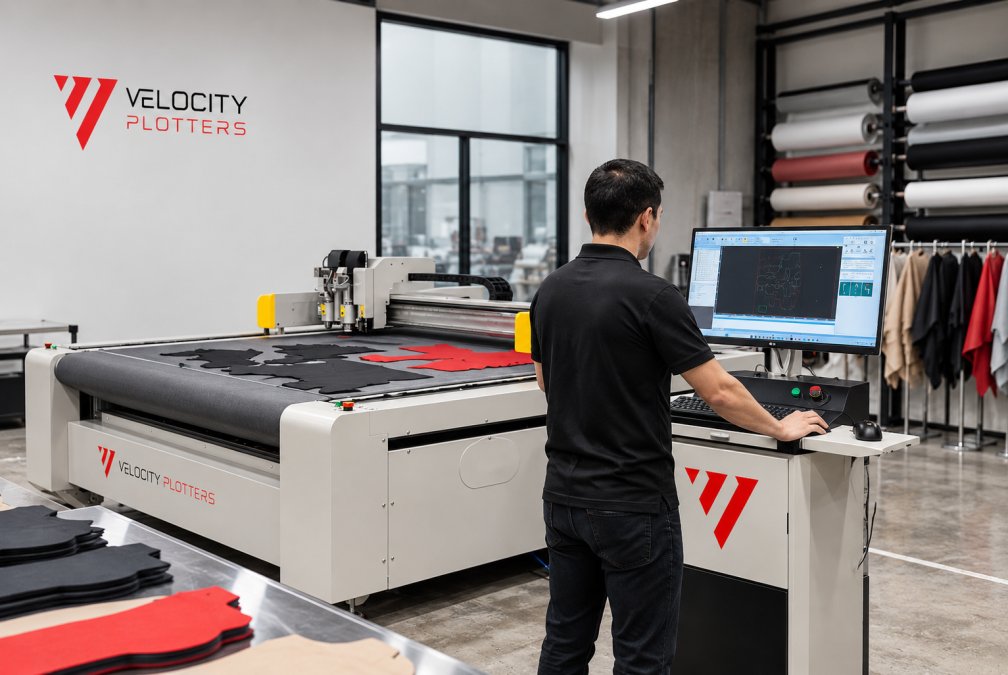
Getting precision cutting right requires a deliberate process. This workflow applies whether you’re using laser, ultrasonic, or mechanical cutting systems.
Preparing Your Material and Equipment
Start with material inspection: check thickness variation, coating consistency, and visible defects, and examine laminates for delamination. Measure thickness at multiple points; variation over 0.5mm indicates a material quality issue cutting won’t solve.
Next, prepare your cutting bed: remove dust and debris and ensure a flat, clean surface, since material on debris cuts unevenly. For coated fabrics, use a mat that won’t stick to tacky coatings and cause slipping.
Load material carefully, aligning it with the system’s reference points. On automated systems, registration marks on the material or bed ensure alignment; misalignment by even 5mm can cause multiple pieces to cut incorrectly.
Configuring Machine Settings and Tolerances
Your cutting system needs three key settings: speed, pressure, and blade path.
Speed determines how quickly the blade moves through material. Faster speeds reduce production time but risk edge damage on technical fabrics; slower speeds give more control and cleaner edges. For coated and laminated materials, start at 50% of maximum and increase incrementally.
Blade pressure is how hard the blade pushes into material. Too little and it doesn’t cut through; too much damages edges or causes delamination. The right pressure is the minimum needed to cut cleanly, often 20-30% less for coated fabrics than uncoated.
Blade path is the exact route the blade takes. For intricate shapes, it determines whether internal corners are sharp or rounded; for straight cuts, it should be perfectly perpendicular to the material edge, since any angle introduces edge damage.
Start with conservative settings. Make a test cut on scrap material. Examine the edge quality under magnification if your tolerance is tight. Look for:
- Clean separation with no fraying
- No discoloration or charring
- No delamination on coated materials
- Consistent edge quality across the entire cut
Adjust one setting at a time. If edges are fraying, try slower speed first. If edges are charring, reduce blade pressure. If cuts are inconsistent, check blade sharpness before adjusting other settings.
Quality Control and Measuring Cut Consistency
After your test cuts, measure the actual dimensions. Use calipers or a precision ruler. Measure at three points on each cut piece, start, middle, and end. This reveals whether the system is cutting consistently along the entire path.
Document your measurements. If you cut five pieces and get dimensions of 12.00, 12.02, 11.99, 12.01, and 12.03 inches, your repeatability is ±0.02 inches, which is excellent. If you get 12.00, 12.10, 11.90, 12.05, and 11.95 inches, your repeatability is ±0.10 inches, which is poor and requires investigation.
Poor repeatability usually points to:
- Blade wear (replace the blade)
- Inconsistent material thickness (source control issue)
- Machine calibration drift (recalibrate)
- Operator technique variation (for manual systems, standardize procedure)
Run quality checks every 50-100 pieces during production. Don’t wait until the end of a run to discover a problem. Early detection prevents scrap accumulation.
Common Cutting Defects and How to Troubleshoot Them
Even with good setup, defects happen. Knowing what causes them speeds up correction.
Fraying or unraveled edges usually means blade pressure is too low or speed is too high. The blade is pushing material aside rather than cutting cleanly. Solution: increase pressure or reduce speed incrementally.
Charring or discoloration indicates heat damage. This occurs with synthetic materials cut at high speed or with dull blades.
Delamination on coated or laminated materials means the layers are separating. This happens when blade pressure is too high or when the cutting angle is wrong.
Inconsistent dimensions across multiple pieces indicates blade wear, calibration drift, or material thickness variation. Solution: measure your material thickness at multiple points to rule out source variation, replace the blade if worn, and recalibrate the machine.
Curved cuts that aren’t smooth often result from dull blades or blade deflection. A dull blade skips rather than cuts cleanly. Blade deflection occurs when pressure is uneven.
Automation and Production Efficiency Gains
Moving from manual to automated cutting transforms production economics. Manual cutting is slow and operator-dependent. A skilled cutter might produce 50-100 pieces per hour.
More important than speed is consistency. Manual cutting has operator variance. One cutter produces slightly different results than another. Automated systems cut identically every time. This consistency reduces scrap and rework.
The real efficiency gain comes from waste reduction. When your cutting accuracy improves from ±5mm to ±1mm, you can nest patterns more efficiently.
Automation also reduces labor cost. One operator can oversee multiple cutting systems running simultaneously. Material handling becomes simpler with automated systems, load material, start the job, and the system handles the rest.
The investment in automated cutting pays back through:
- Reduced material waste
- Faster production
- Lower labor per unit
- Fewer defects and rework
- Ability to handle more complex designs
For small operations with 15 people in the cutting room, automation scales efficiently. A single precision cutting system can replace two to three manual cutters while improving quality.
Precision cutting for technical fabrics isn’t just about owning the right equipment, it’s about understanding your materials, configuring your system correctly, and maintaining quality discipline throughout production.
Frequently Asked Questions
What is the best cutting machine for technical fabrics?
The best choice depends on your fabric type and production volume. Laser cutters excel with synthetic technical fabrics and deliver contactless, clean cuts with minimal fraying. Ultrasonic cutters work well for coated and laminated fabrics. Knife-based systems handle heavier technical textiles and leather. Automated systems reduce operator fatigue and improve cutting consistency across production runs. Evaluate your specific material properties, required precision tolerances, and throughput before selecting equipment.
How can automated cutting reduce material waste?
Automated high precision cutting systems optimize nesting—the arrangement of pattern pieces on fabric—to minimize scrap. Digital design-to-production workflows eliminate manual layout errors that cause miscuts and waste. Consistent cutting accuracy means fewer rejected pieces due to dimensional errors. Automated systems also enable batch processing of similar patterns, further improving material utilization. Many manufacturers report significant waste reduction after implementing precision automated cutting versus manual methods.
Which cutting method works best for coated or laminated fabrics?
Ultrasonic and hot cutting methods are ideal for coated and laminated fabrics because they seal edges while cutting, preventing delamination and fraying. Laser cutting can work but may damage heat-sensitive coatings. Knife-based systems require careful blade sharpness and feed speed control to avoid tearing the coating layers. Test your specific material with each method, as coating composition and thickness affect results. Edge quality and material integrity matter more with laminates than with uncoated fabrics.
What tolerances should I set for high precision fabric cutting?
Your tolerance targets should match your end-product specifications and downstream assembly requirements. Regularly measure cut pieces using calipers or digital measurement tools to verify your machine maintains target tolerances throughout production runs.



 EN_US
 ES